

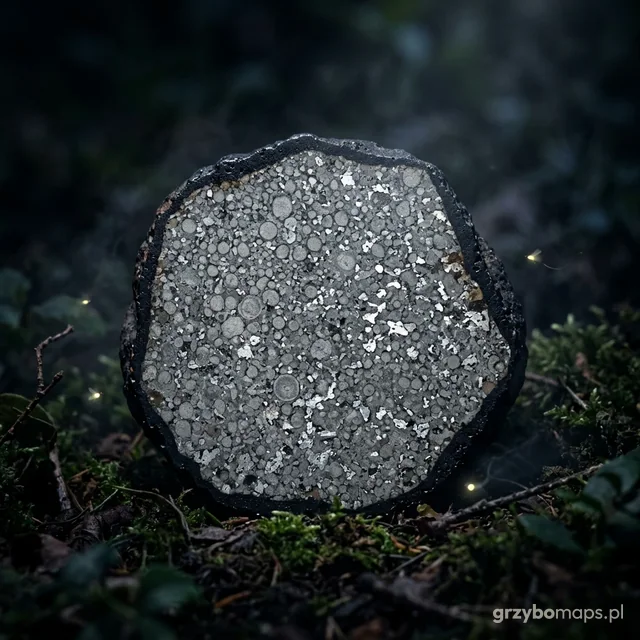
Pułtusk meteorite
Ordinary chondrite.
On the evening of 30 January 1868 a shower of stones fell over Pułtusk. Estimates speak of tens of thousands of specimens, and thousands of them lie in collections around the world. It is one of the most famous meteorite falls in the world.
What it is
Ordinary chondrite (a stony meteorite with tiny chondrules and metal grains).
How to recognise
- Black, matte fusion crust, thin as lacquer.
- Under the crust a light grey interior with flecks of shiny metal.
- Heavier than an ordinary stone and usually weakly attracts a magnet.
- Basalt and slag have no fusion crust or metal grains.
How and where to look
After more than 150 years specimens are still found with a detector or a magnet in the fields east of Pułtusk. The owner's permission is required, and for searching with a detector it is worth having a permit from the heritage conservator, because historic artefacts also lie in the ground. Report your find to scientists.
Known places in Poland
- Pułtusk and surroundings (Gostkowo, Rzewnie) (woj. mazowieckie): Farmland: search only with the owners' permission.
Meaning and legends
The residents of the time described a roar and fiery balls in the sky; the press wrote about a 'rain of stones'. The fall helped science understand that meteorites are fragments of asteroids.
Fun fact
Staff of the Astronomical Observatory of the University of Warsaw collected about 400 specimens right after the fall.