

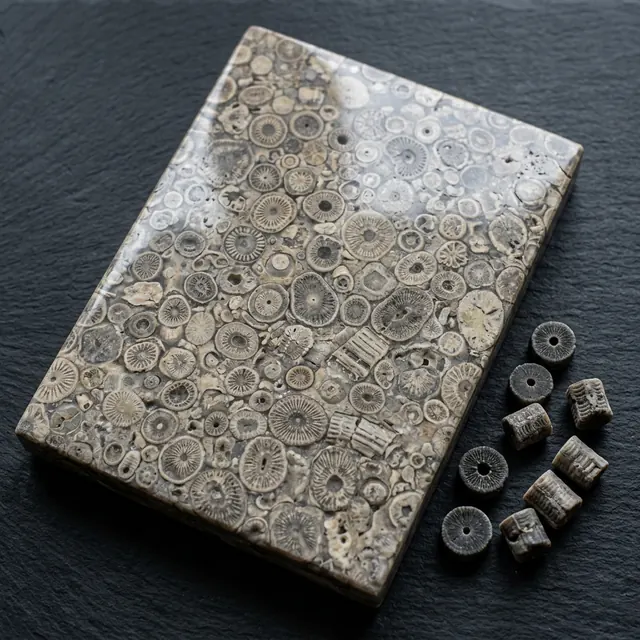
Fossil crinoids (trochites)
Fossilised remains of crinoids, marine echinoderms
Crinoids look like a flower on a stem, but they are animals related to sea urchins and starfish. After death their skeleton fell apart, which is why you usually find stem discs, and whole calyxes are rare. Mass accumulations form crinoid limestones, in Poland in the Devonian and Carboniferous of the Holy Cross Mountains, in the Triassic of Silesia and the Kraków area, and in the Jurassic of the Tatras and Pieniny.
What it is
Fossilised remains of crinoids (Crinoidea), marine echinoderms; most often single stem segments called trochites.
How to recognise
- Small discs or cylinders, often stacked in a column like a pile of coins, with a little hole in the middle.
- Each segment is a single calcite crystal, so on a fresh break it glitters with smooth cleavage planes.
- In crinoid limestone you can see hundreds of round and oval cross-sections of segments.
- Belemnites are cigar-shaped and are not made of discs; corals have radial partitions in their cups.
How and where to look
Look on the surfaces of weathered limestones, in the spoil heaps of old quarries and in river pebbles, with the permission of the land manager. Trochites are easy to see after rain, when the rock is wet. The Geological and Mining Law (art. 4) does not cover the collecting of specimens of minerals, rocks and fossils for collecting, scientific and educational purposes, provided it is done without mining works. In nature reserves and national parks, collecting minerals and fossils is prohibited (Nature Conservation Act, art. 15). On other people's land, in a forest and in a quarry you need the consent of the owner, the forest district or the manager.
Known places in Poland
- Gogolin (woj. opolskie): A town on Triassic limestones (the Gogolin Formation); the old quarries are disused and have owners, enter with permission.
- Góra Św. Anny Reserve (woj. opolskie): A geological reserve in an old quarry of limestone and nephelinite: viewing only, collecting is prohibited.
- Wietrznia, Kielce (woj. Świętokrzyskie): An old quarry of Devonian limestones, now a reserve: viewing from the paths only.
Meaning and legends
They were already described in the 16th century by Conrad Gessner and Georgius Agricola, though they did not know that these were remains of animals. An old name for a stem segment is trochite (today columnale). In Germany, crinoid segments from the Muschelkalk limestone were called St Boniface's pennies or witches' money; these are old beliefs and nicknames, not facts.
Fun fact
The largest Jurassic crinoids grew up to 19 m; in the shales of Holzmaden fifty specimens were found attached to a single drifting trunk.