

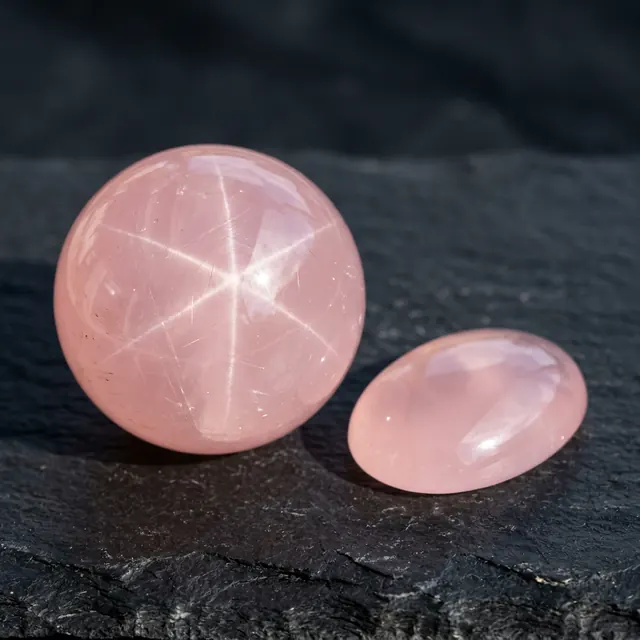
Rose quartz
A pink variety of quartz, coloured by trace amounts of manganese, iron or titanium.
It usually forms compact, granular masses, and well-formed crystals are a rarity. In Poland it has been found in the pegmatites of the Góry Sowie and their foreland (around Bielawa, Piława Górna and Walim), in quartz veins of the Izerskie Garby and in the alluvium of Hala Izerska.
What it is
A pink variety of quartz (SiO2), coloured by trace amounts of manganese, iron or titanium.
How to recognise
- Colour from pale pink to pinkish red, transparent to translucent.
- Massive lumps without crystal faces, conchoidal fracture, glassy to waxy lustre.
- Hard (7): it scratches glass.
- Sometimes under strong light a six-rayed star (asterism) can be seen, caused by rutile needles.
How and where to look
Look in quartz veins, in pegmatites and among pebbles in stream beds. Geological and mining law (art. 4) does not cover the collecting of specimens of minerals, rocks and fossils for collecting, scientific and teaching purposes, if it is done without mining works. In nature reserves and national parks, collecting minerals and fossils is forbidden (Nature Conservation Act, art. 15). On someone else's land, in a forest and in a quarry, the permission of the owner, the forest district or the manager is required.
Known places in Poland
- Bielawa (Góry Sowie) (woj. dolnośląskie): Pegmatites of the Góry Sowie; in the forest, the permission of the forest district is required, in nature reserves collecting is forbidden.
- Piława Górna (woj. dolnośląskie): The foreland of the Góry Sowie; quarries and fields are private, ask for permission.
- Hala Izerska (Izera Mountains) (woj. dolnośląskie): Pebbles in alluvium; the surrounding areas are valuable for nature, do not dig in the peat bogs and observe the bans in nature reserves.
Meaning and legends
Valued as an ornamental stone for brooches, pendants and necklaces, usually cut as a cabochon or a sphere. Modern esotericism calls it the stone of love; that is a belief, not a fact.
Fun fact
Rose quartz is most often accompanied by smoky quartz, and tree-like dendrites of manganese oxides sometimes occur inside.