

Smoky quartz
A brown to almost black variety of quartz
It forms well-developed, six-sided crystals in the cavities of pegmatites. In Poland the finest specimens come from the granites of the Strzegom-Sobótka massif. The largest Polish crystals were up to 100 cm long and weighed up to 60 kg.
What it is
A brown to almost black variety of quartz (SiO2); its dark colour comes from natural radiation in the rocks.
How to recognise
- Six-sided prisms ending in a sharp pyramid, colour from pale beige through brown to almost black.
- Hard: it scratches glass, and a steel knife does not scratch it.
- Conchoidal fracture, no cleavage; white streak.
- Brown glass has no natural crystal faces; imitations may show traces of glue and artificial-looking tips.
How and where to look
Look in the cavities (vugs) of pegmatites in granite and on the spoil heaps of old quarries, always with the manager's permission. A quarry is a danger zone: wall collapses, heavy machinery and blasting; do not go near the walls, and wear a helmet and goggles. The Karkonosze also have smoky quartz, but that is a national park. Geological and mining law (art. 4) does not cover the collecting of specimens of minerals, rocks and fossils for collecting, scientific and teaching purposes, if it is done without mining works. In nature reserves and national parks, collecting minerals and fossils is forbidden (Nature Conservation Act, art. 15). On someone else's land, in a forest and in a quarry, the permission of the owner, the forest district or the manager is required.
Known places in Poland
- Strzegom (Strzegom-Sobótka granite massif) (woj. dolnośląskie): A major stone-working centre with many granite quarries; these are active, private works, entry only with permission and with a guide.
- Siedlimowice (woj. dolnośląskie): One of the frequently listed smoky quartz sites in granites; old and active quarries are private, ask for permission.
- PAN Museum of the Earth, Warsaw (woj. mazowieckie): Mineral specimens from Poland can be viewed in the museum's collections.
Meaning and legends
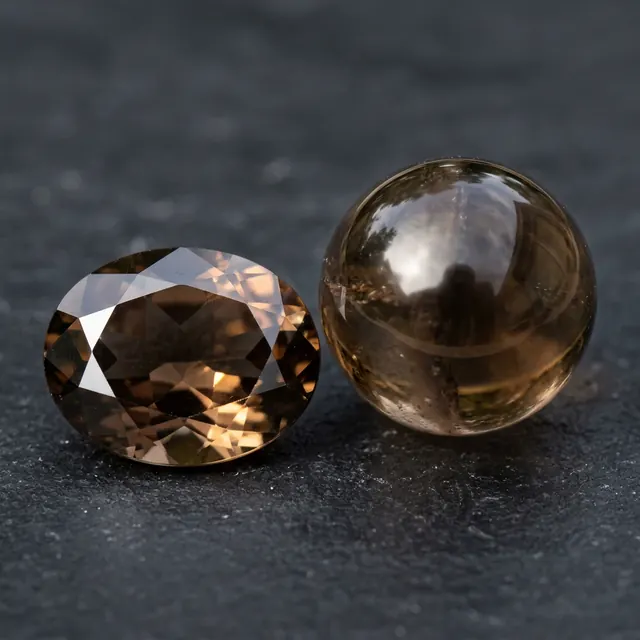
It used to be sold under the misleading name smoky topaz. It is usually cut with facets, more rarely as a cabochon or a sphere. The modern attribution of protective properties to it is an esoteric belief, not fact.
Fun fact
A similar colour can be given to rock crystal artificially by irradiating it, so a dark colour does not always prove that a specimen is of natural origin.