

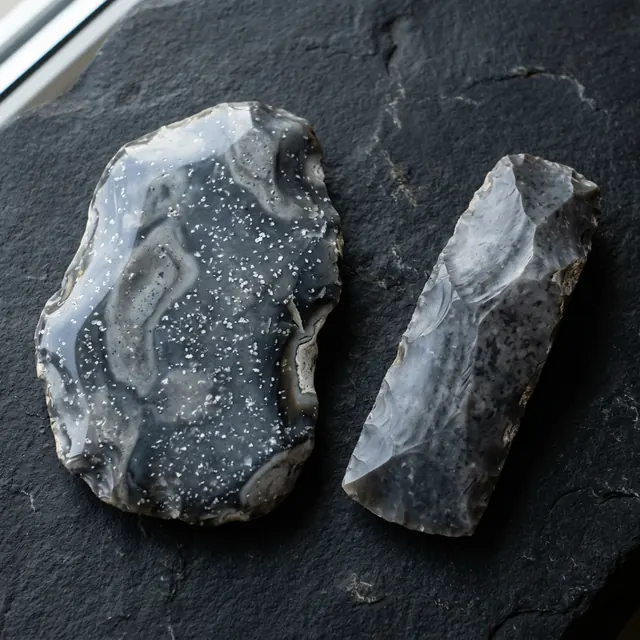
Świeciechów flint
Grey flint with white speckles from the Upper Cretaceous limestones around Annopol on the Vistula.
Prehistoric people mined it from the end of the Palaeolithic to the beginning of the Bronze Age. They used rich secondary deposits about 60 cm below the surface, where from 1 m3 of sediment several dozen nodules could be extracted, up to 50 cm long. The variety was distinguished in 1923 by the geologist Jan Samsonowicz.
What it is
Grey flint with white speckles from the Upper Cretaceous (Turonian) limestones around Annopol on the Vistula.
How to recognise
- Grey, from light to dark or bluish, sometimes brownish; several shades with a sharp boundary in one block.
- Characteristic white calcite specks about 1 mm in diameter.
- Sharp edges when chipped, conchoidal fracture, scratches glass.
- Banded flint from Krzemionki has bands, and chocolate flint is brown and without white dots.
How and where to look
Numerous fragments lie on the surface of the fields, but they are heavily weathered. Collecting loose stones on someone else's field requires the farmer's permission. Flint flakes, cores and tools are archaeological monuments: they belong to the State Treasury, you must not keep them or carry out excavations, and a find must be reported to the voivodeship monument conservator. Flint produces razor-sharp splinters when knapped, so protect your eyes and hands. Geological and mining law (art. 4) does not cover the collecting of specimens of minerals, rocks and fossils for collecting, scientific and teaching purposes, if it is done without mining works. In nature reserves and national parks, collecting minerals and fossils is forbidden (Nature Conservation Act, art. 15). On someone else's land, in a forest and in a quarry, the permission of the owner, the forest district or the manager is required.
Known places in Poland
- Świeciechów Duży (Świeciechów-Lasek site) (woj. lubelskie): A prehistoric mine covering about 1 km2 above the Vistula valley; it is an archaeological site, digging is not allowed, and the fields are private.
- Annopol (woj. lubelskie): The Vistula gorge cut through a Cretaceous flint bed here; observe the outcrops from roads and paths.
Meaning and legends
Tools were made from it by the Magdalenian and Swiderian cultures, Mesolithic peoples and the Neolithic Funnel Beaker culture, which made axes and long blades from it. We do not know whether people of the past also valued it for its beauty; that is only a supposition.
Fun fact
The white specks are calcite heavily saturated with silica, which is why the flint split evenly despite these inclusions.