

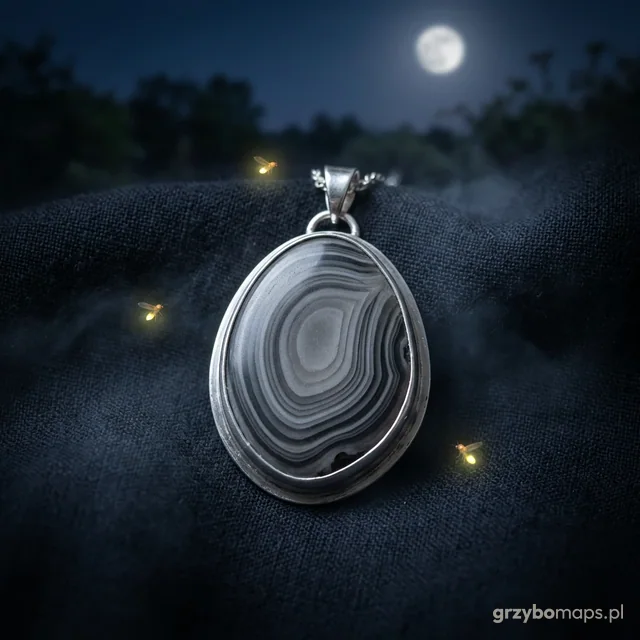
Banded flint
A siliceous sedimentary rock from the Jurassic, with characteristic bands in shades of grey.
It occurs only on the north-eastern edge of the Holy Cross Mountains. In the Neolithic it was mined at Krzemionki for axes. Today it is a prized jewellery stone from Sandomierz.
What it is
A siliceous sedimentary rock (mainly chalcedony and quartz) from the Jurassic, with characteristic bands in shades of grey.
How to recognise
- Nodules or flat concretions with distinct concentric bands of grey, ash-grey and black.
- Conchoidal fracture with sharp edges.
- A white limy crust on the surface.
- Baltic flint is uniformly grey or black; agate has bands around a cavity and a different origin.
How and where to look
In the fields around Krzemionki and in old limestone quarries, but not in the reserve. Single nodules turn up in arable soil and on spoil heaps. The Geological and Mining Law (art. 4) does not cover obtaining specimens of minerals, rocks and fossils for collecting, scientific and educational purposes, if this is done without mining works. In nature reserves and national parks, collecting minerals and fossils is prohibited (Nature Conservation Act, art. 15). On someone else's land, in a forest and in a quarry, you need the permission of the owner, the forest district or the manager.
Known places in Poland
- Krzemionki near Ostrowiec Świętokrzyski (woj. Świętokrzyskie): An archaeological reserve and a UNESCO site (2019); collecting is forbidden, an underground route is open to visitors.
- Sandomierz (woj. Świętokrzyskie): Workshops and a banded flint festival; here you can see it and buy it.
Meaning and legends
Neolithic miners sank shafts and galleries here about 5,000 years ago, and axes of banded flint travelled far across Central Europe. In 1972 the Sandomierz goldsmith Cezary Łutowicz introduced it into jewellery and called it the 'stone of optimism'.
Fun fact
The mines at Krzemionki were discovered by Jan Samsonowicz on 19 July 1922.