

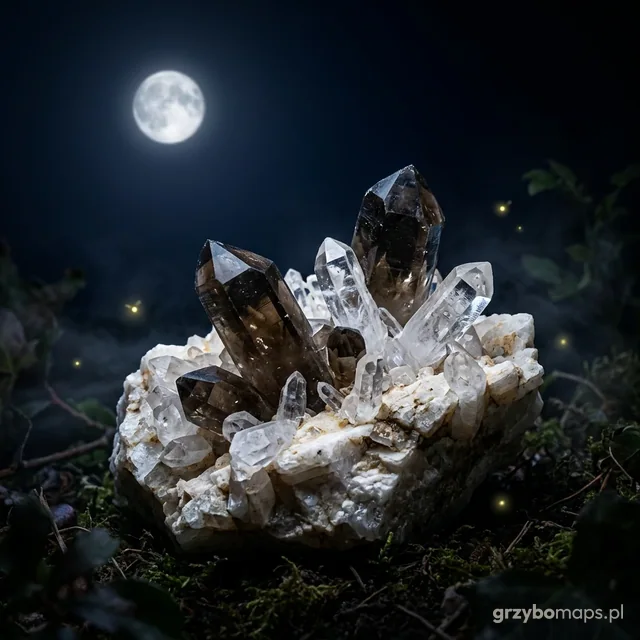
Rock crystal and quartz
Quartz, the most common mineral of the Earth's crust
The most beautiful Polish quartz crystals come from cavities (druses) in the granite pegmatites of Strzegom and the Karkonosze. Ordinary milky quartz you will meet in every Sudeten stream.
What it is
Quartz (SiO2), the most common mineral of the Earth's crust; rock crystal is its colourless, transparent variety, and smoky quartz and morion are the brown and black varieties.
How to recognise
- Hexagonal columns with a small pyramid and cross-striations on the faces.
- It scratches glass and cannot itself be scratched by steel.
- It does not cleave, conchoidal fracture.
- Calcite is soft and cleaves into rhombs; glass has bubbles and no striations.
How and where to look
Look for cavities in granite (druses) on quarry spoil heaps, for fragments in streams and in fields. In an active quarry you may enter only with permission and wearing a helmet. The Geological and Mining Law (art. 4) does not cover obtaining specimens of minerals, rocks and fossils for collecting, scientific and educational purposes, if this is done without mining works. In nature reserves and national parks, collecting minerals and fossils is prohibited (Nature Conservation Act, art. 15). On someone else's land, in a forest and in a quarry, you need the permission of the owner, the forest district or the manager.
Known places in Poland
- Granite quarries in the Strzegom area (woj. dolnośląskie): Active quarries: entry only with the permission of the operator; 57 pegmatite minerals are described here.
- Szklarska Poręba (woj. dolnośląskie): Karkonosze granite with pegmatites; Karkonosze National Park is excluded from collecting.
Meaning and legends
The Romans, following Pliny, considered rock crystal to be ice frozen so hard that it no longer melts; hence the Greek name krystallos. Crystal was used to make fortune-telling balls and reliquaries; that is tradition.
Fun fact
Quartz has piezoelectric properties, which is why quartz plates keep time in watches.