

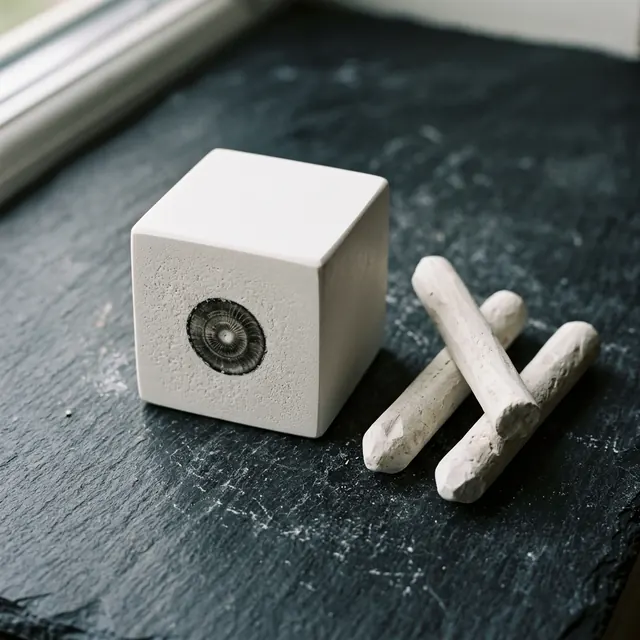
Writing chalk
A soft, white sedimentary rock of calcite, built mainly of microscopic shells of coccoliths and foraminifera.
It formed on the floor of an ancient sea. It is porous and light, and stains the fingers. In Poland large deposits lie around Chełm, Zamość and Siedlce, and open-pit chalk mines operate in Mielnik and Stara Kornica. Fossils occur in it as a minor component, e.g. belemnites, bivalves and sponge spicules.
What it is
A soft, white sedimentary rock of calcite (CaCO3), built mainly of microscopic shells of coccoliths and foraminifera.
How to recognise
- White, matt, light and porous; it leaves a mark on the fingers and on a board.
- A drop of diluted vinegar or hydrochloric acid makes it fizz, because it is calcite.
- Gypsum is also white and soft, but it does not fizz with acid.
- Lake chalk is often greyish, mixed with clay and plant remains; it has a different origin.
How and where to look
Chalk can be seen in valley slopes and in pits in the Lublin region and Podlasie. Do not enter active mines without permission: there is a risk of rockfalls, heavy machinery and flooded pits. In chalk it is worth looking out for belemnites and sea urchins. The Geological and Mining Law (art. 4) does not cover the collecting of specimens of minerals, rocks and fossils for collecting, scientific and educational purposes, provided it is done without mining works. In nature reserves and national parks, collecting minerals and fossils is prohibited (Nature Conservation Act, art. 15). On other people's land, in a forest and in a quarry you need the consent of the owner, the forest district or the manager.
Known places in Poland
- Chalk Underground in Chełm (woj. lubelskie): A historic chalk mine with a tourist route of about 2 km under the old town; a constant +9 °C underground. Do not chip chalk off the walls.
- Mielnik on the Bug (woj. podlaskie): The active open-pit mine of the Mielnik Chalk Works: the works area is closed, do not enter the pit. Next to it is the Góra Uszeście nature reserve, where reserve bans apply.
Meaning and legends
In Chełm chalk was extracted from the 13th century, often straight from house cellars; in the 17th century 80 out of 100 houses in the centre had an entrance to the underground. The legend of the Chełm underground tells of the spirit Bieluch, ruler of the passages; it is a folk tale, not fact.
Fun fact
The name Mielnik is derived from the Old East Slavic word mieł, meaning chalk; this was confirmed by archaeological research from 2017.