

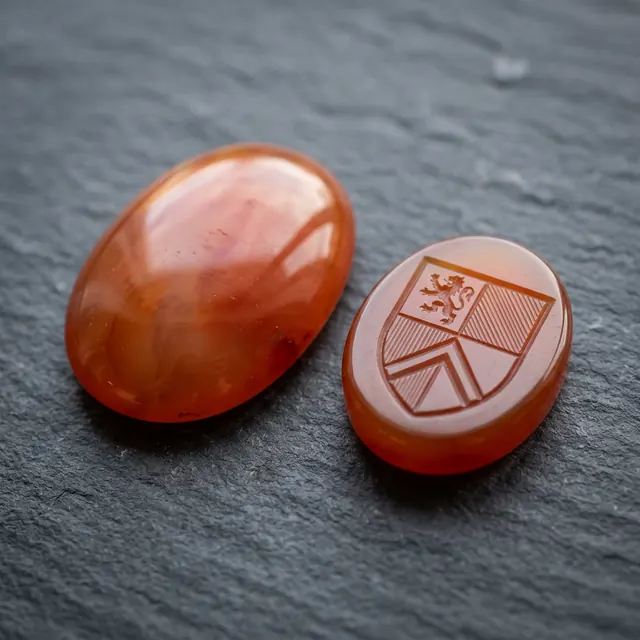
Carnelian
A red, translucent variety of chalcedony, coloured by inclusions of iron oxides and hydroxides.
Its colour ranges from orange and coral to brownish red, with a waxy lustre. In Poland it occurs in the melaphyres around Kamienna Góra and Kłodzko and in the former nickel-bearing serpentinite mine at Szklary. For centuries it was used to make seals and signet rings.
What it is
A red, translucent variety of chalcedony (SiO2), coloured by inclusions of iron oxides and hydroxides.
How to recognise
- Red to orange-brown, translucent against the light, waxy lustre.
- Natural carnelian against the light shows a streaky, feathery colour distribution; dyed agate has its colour arranged in rings.
- Hard: it scratches glass; conchoidal fracture, white streak.
- Jasper, with which it is sometimes confused, is completely opaque.
How and where to look
Look in fields and on spoil heaps in the melaphyre area, best after rain, when the red fragments shine. Do not enter the old workings in Szklary: in 1994 two stone hunters spent 24 days trapped there. Geological and mining law (art. 4) does not cover the collecting of specimens of minerals, rocks and fossils for collecting, scientific and teaching purposes, if it is done without mining works. In nature reserves and national parks, collecting minerals and fossils is forbidden (Nature Conservation Act, art. 15). On someone else's land, in a forest and in a quarry, the permission of the owner, the forest district or the manager is required.
Known places in Poland
- Kamienna Góra (woj. dolnośląskie): A melaphyre area; fields and quarries are private, enter only with the owner's permission.
- Kłodzko (surroundings) (woj. dolnośląskie): Sites in the melaphyres around the town; ask the landowners for permission.
- Szklary near Ząbkowice Śląskie (woj. dolnośląskie): A former nickel mine; the old adits risk collapse, do not enter them. You can legally visit the route in the Robert adit.
Meaning and legends
The name probably comes from the Old French cornele, the fruit of the cornel. In Poland, coats of arms were engraved in it on signet rings. Old beliefs attributed to it the power to add courage; that is tradition, not fact.
Fun fact
Most carnelians on the market are dyed and heat-treated agates; heating deepens the red in natural stones too.