

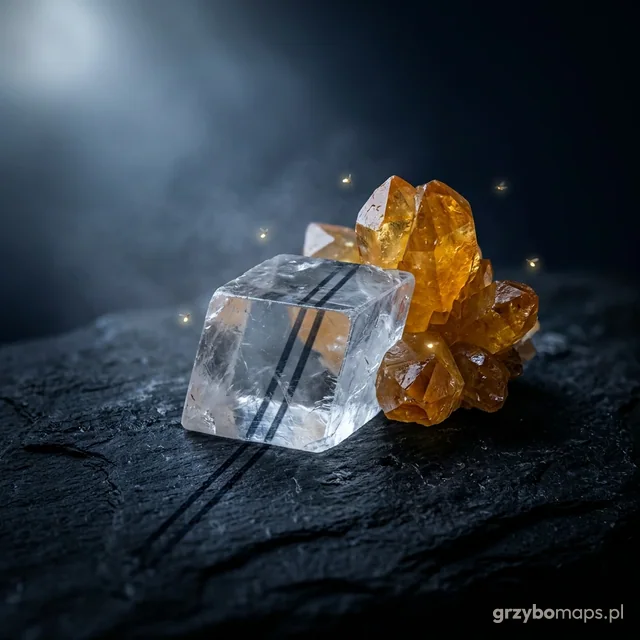
Calcite
Calcium carbonate, the main component of limestones and marbles.
Calcite builds cave formations and veins in limestones. The Holy Cross Mountains have plenty of it, e.g. in Kadzielnia and in Raj Cave.
What it is
Calcium carbonate (CaCO3), the main component of limestones and marbles.
How to recognise
- Colourless, white, honey-coloured; it cleaves into rhombohedra.
- It fizzes in vinegar or hydrochloric acid.
- A knife scratches it.
- Quartz is hard and does not cleave; gypsum is even softer (a fingernail scratches it).
How and where to look
On the dumps of limestone quarries and in veins in rocks, outside reserves and caves (cave formations must not be destroyed). The Geological and Mining Law (art. 4) does not cover collecting specimens of minerals, rocks and fossils for collecting, scientific and educational purposes, as long as it is done without mining works. Collecting minerals and fossils is prohibited in nature reserves and national parks (Nature Conservation Act, art. 15). On someone else's land, in a forest and in a quarry, you need permission from the owner, the forest district or the manager.
Known places in Poland
- Kadzielnia, Kielce (woj. Świętokrzyskie): Geological reserve in the city centre; look only.
- Raj Cave (woj. Świętokrzyskie): Reserve, guided tours.
Meaning and legends
Transparent calcite (Iceland spar) doubles the image; the Vikings may have used such crystals as 'sunstones' for navigation. This is a researchers' hypothesis.
Fun fact
Traces of the presence of Neanderthals were found in Raj Cave.