

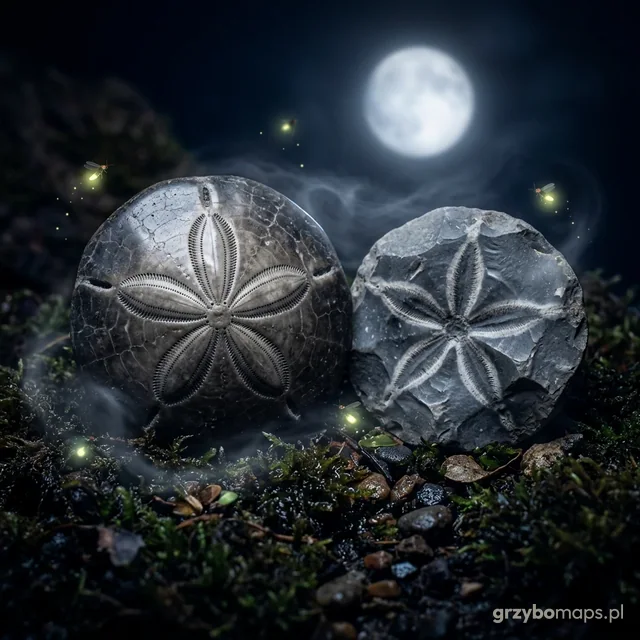
Fossil sea urchin
The fossilised test of a sea urchin from the Cretaceous
Spherical or heart-shaped tests with a five-rayed star are common finds in the chalk of Mielnik and in the Lublin region. In the north of the country, flint casts of sea urchins turn up in glacial gravels.
What it is
The fossilised test of a sea urchin from the Cretaceous; of calcite or as a flint cast of the interior.
How to recognise
- A small dome or heart the size of a nut, with five rays of dotted bands.
- The mouth opening is on the underside, the anal opening at the side or at the top.
- Flint casts are smooth and grey, but with the same five-rayed symmetry.
- Ordinary pebbles do not have five-rayed symmetry.
How and where to look
In chalk spoil heaps, in gravel pits and in fields in the north of Poland. The general rules apply. The Geological and Mining Law (art. 4) does not cover obtaining specimens of minerals, rocks and fossils for collecting, scientific and educational purposes, if this is done without mining works. In nature reserves and national parks, collecting minerals and fossils is prohibited (Nature Conservation Act, art. 15). On someone else's land, in a forest and in a quarry, you need the permission of the owner, the forest district or the manager.
Known places in Poland
- Mielnik, a chalk mine (woj. podlaskie): With the company's permission.
- Kazimierz Dolny (woj. lubelskie): Cretaceous opoka marls; do not dig in the ravines.
Meaning and legends
In England and the countries of Northern Europe sea urchins were called 'thunderstones' and 'shepherds' crowns' and were placed on windowsills against lightning; they also ended up in graves, e.g. a Bronze Age burial at Dunstable Down. Sources do not confirm Polish folk names for sea urchins as clearly as for belemnites. These are beliefs.
Fun fact
The five-rayed symmetry of sea urchins links them with starfish.