

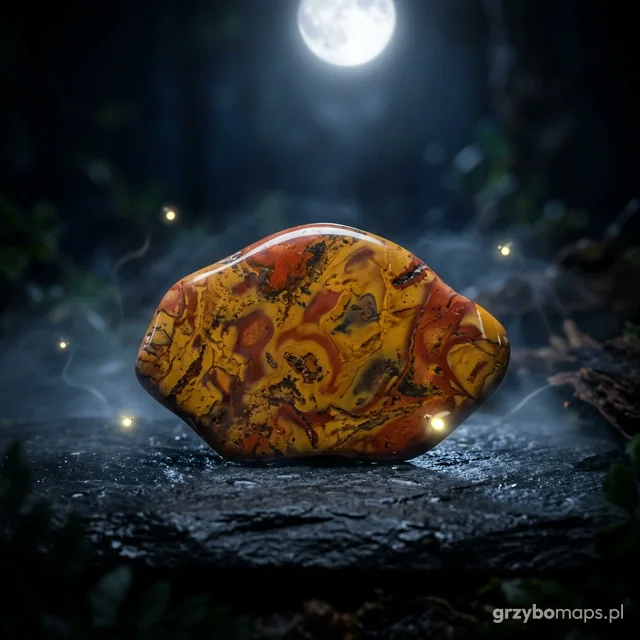
Jasper
An opaque, compact variety of silica strongly coloured by iron oxides.
Jaspers occur in Lower Silesia among Permian lavas, and the best-described deposit lies at Świerki near Nowa Ruda, where the jasper layer is up to 1.8 m thick.
What it is
An opaque, compact variety of silica (chalcedony and quartz) strongly coloured by iron oxides.
How to recognise
- Opaque, red, brown, yellow or green, often mottled.
- Smooth, conchoidal fracture, as hard as quartz.
- No bands around a cavity as in agate.
- Ordinary sandstone is grainy and dull; red feldspar cleaves into flat faces.
How and where to look
Look for fragments in streams and fields in the areas of Permian lavas in the Sudetes, often together with agates. The pieces are sharp-edged, not spherical. The Geological and Mining Law (art. 4) does not cover obtaining specimens of minerals, rocks and fossils for collecting, scientific and educational purposes, if this is done without mining works. In nature reserves and national parks, collecting minerals and fossils is prohibited (Nature Conservation Act, art. 15). On someone else's land, in a forest and in a quarry, you need the permission of the owner, the forest district or the manager.
Known places in Poland
- Świerki near Nowa Ruda (woj. dolnośląskie): Jaspers among Permian melaphyres and porphyries; forest and private land, with permission.
Meaning and legends
The Bible names jasper among the twelve stones on the high priest's breastplate and in the foundations of the New Jerusalem. Lapidaries ascribed to it protection of travellers; these are beliefs.
Fun fact
Flint, chalcedony, agate and jasper are chemically the same compound, silica; they differ in structure and impurities.