

Hematite
Iron oxide, an iron ore.
Hematite occurs in the Holy Cross Mountains and the Sudetes. In Chęciny it colours the red 'różanka' rock, and in Rudki it was an ore mined together with pyrite.
What it is
Iron oxide (Fe2O3), an iron ore.
How to recognise
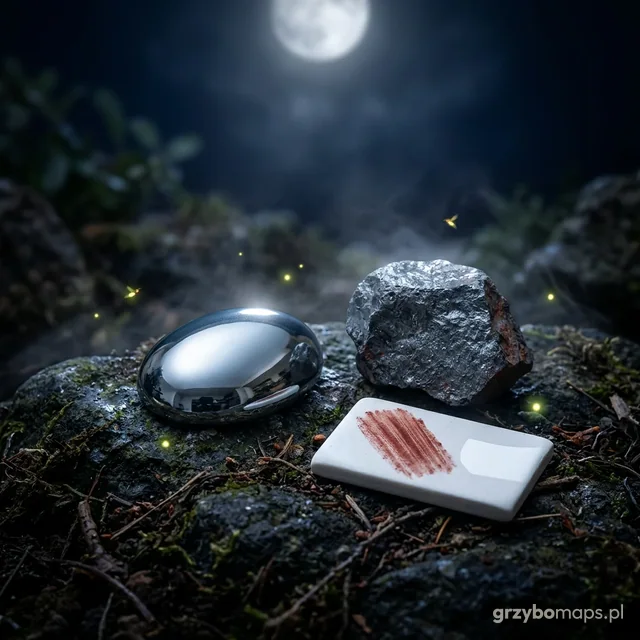
- Steel-grey, black or red, metallic or earthy.
- Always a red-brown streak on porcelain.
- Heavy, not attracted to a magnet (or only weakly).
- Magnetite has a black streak and strong magnetism.
How and where to look
On the dumps of former iron ore mines and in quarries. A streak test on unglazed porcelain settles it. The Geological and Mining Law (art. 4) does not cover collecting specimens of minerals, rocks and fossils for collecting, scientific and educational purposes, as long as it is done without mining works. Collecting minerals and fossils is prohibited in nature reserves and national parks (Nature Conservation Act, art. 15). On someone else's land, in a forest and in a quarry, you need permission from the owner, the forest district or the manager.
Known places in Poland
- Rudki (Nowa Słupia municipality) (woj. Świętokrzyskie): Dumps of a former mine; with permission.
- Zelejowa near Chęciny (woj. Świętokrzyskie): Reserve: look at the 'różanka zelejowska' only.
Meaning and legends
The name comes from the Greek haima (blood), because the powder is blood-red. Hematite ochre served as a pigment from the Palaeolithic, and in old magic as 'bloodstone' protecting against haemorrhage; this is a belief.
Fun fact
The red colour of Mars comes from fine iron oxides and hydroxides, relatives of hematite.