

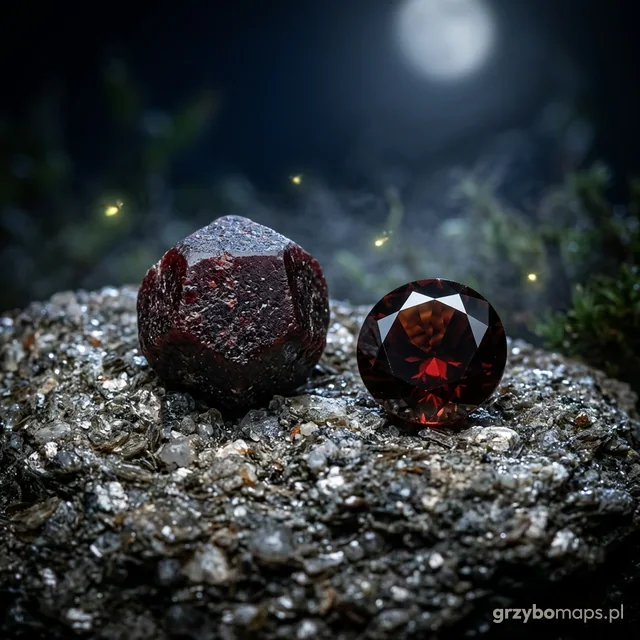
Garnet (almandine)
An aluminium iron silicate of the garnet group, forming dark red dodecahedral crystals.
Small dark red garnets sit in the schists and gneisses of the Sudetes, e.g. in the skarns of Kowary. The Baltic beaches have pink streaks of sand made of garnet grains. People often take them for rubies, but rubies are practically never found in Poland.
What it is
An aluminium iron silicate of the garnet group, forming dark red dodecahedral crystals.
How to recognise
- Spherical crystals with many faces (dodecahedron), embedded in the rock.
- Colour from dark red to brownish violet, vitreous lustre.
- Harder than glass.
- Ruby is corundum, it has the shape of a hexagonal plate or prism and is even harder; there are no deposits of it in Poland.
How and where to look
In the Sudetes, look at mica schists and gneisses in outcrops and streams. At the sea, look for pinkish strips of heavy sand after a storm. Karkonosze National Park is excluded from collecting. The Geological and Mining Law (art. 4) does not cover obtaining specimens of minerals, rocks and fossils for collecting, scientific and educational purposes, if this is done without mining works. In nature reserves and national parks, collecting minerals and fossils is prohibited (Nature Conservation Act, art. 15). On someone else's land, in a forest and in a quarry, you need the permission of the owner, the forest district or the manager.
Known places in Poland
- Kowary (Rudawy Janowickie) (woj. dolnośląskie): Garnets in the skarns of old mines; the adits are tourist routes, the spoil heaps are partly in forest.
- The beach at Łeba (woj. pomorskie): Pink and purple streaks of sand made of garnet grains; Słowiński National Park is right next to it, take nothing from there.
Meaning and legends
The name comes from the Latin granatum (pomegranate). Medieval lapidaries linked it with blood and courage, and travellers wore it as an amulet; these are beliefs. In the past Bohemian garnets (pyrope) were fashionable jewellery across Central Europe.
Fun fact
In stream sands in the Izerskie Meadows you can find tiny grains of corundum (sapphires), but a ruby in Poland is still an almost legendary rarity.