

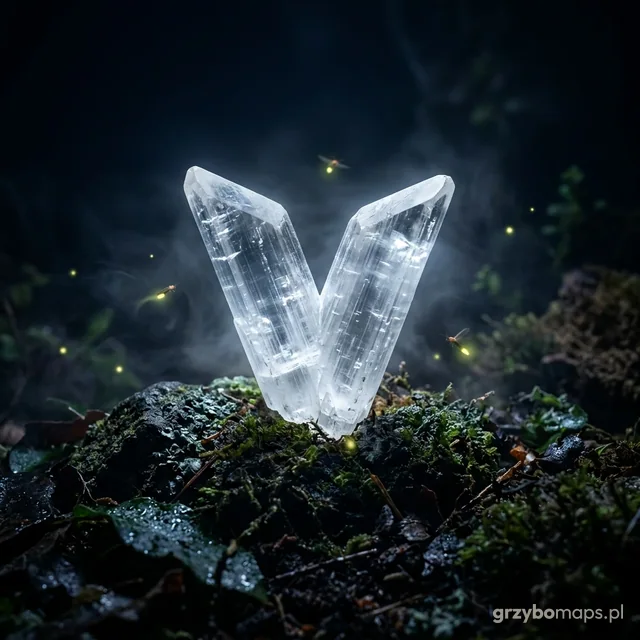
Gypsum and selenite
Hydrated calcium sulphate
On the Ponidzie, around Busko, Wiślica and Pińczów, lie Miocene gypsums. Selenite is formed by vertical crystals up to 3.5 m tall, intergrown into 'swallowtails'.
What it is
Hydrated calcium sulphate (CaSO4·2H2O); selenite is gypsum in the form of large transparent crystals.
How to recognise
- Soft: a fingernail scratches it.
- Transparent plates that cleave into thin, flexible sheets.
- Twinned crystals in the shape of a swallowtail.
- Calcite fizzes in acid and cannot be scratched with a fingernail.
How and where to look
Fragments of selenite can be seen in outcrops and in the fields of the Ponidzie. There are many reserves and the Nadnidziański Landscape Park: collect only from fields with the farmer's permission. The Geological and Mining Law (art. 4) does not cover collecting specimens of minerals, rocks and fossils for collecting, scientific and educational purposes, as long as it is done without mining works. Collecting minerals and fossils is prohibited in nature reserves and national parks (Nature Conservation Act, art. 15). On someone else's land, in a forest and in a quarry, you need permission from the owner, the forest district or the manager.
Known places in Poland
- Skorocice near Busko (woj. Świętokrzyskie): Gypsum karst reserve: look only.
- Zimne Wody reserve, Busko-Zdrój (woj. Świętokrzyskie): Fissures in gypsums; look only.
Meaning and legends
Transparent selenite was formerly used in place of window panes; hence its Polish name 'szklica' (from szkło, glass). Houses were built and mortars made from the gypsum of the Ponidzie.
Fun fact
Selenite crystals grew on the floor of a shallow, evaporating sea about 13 million years ago.