

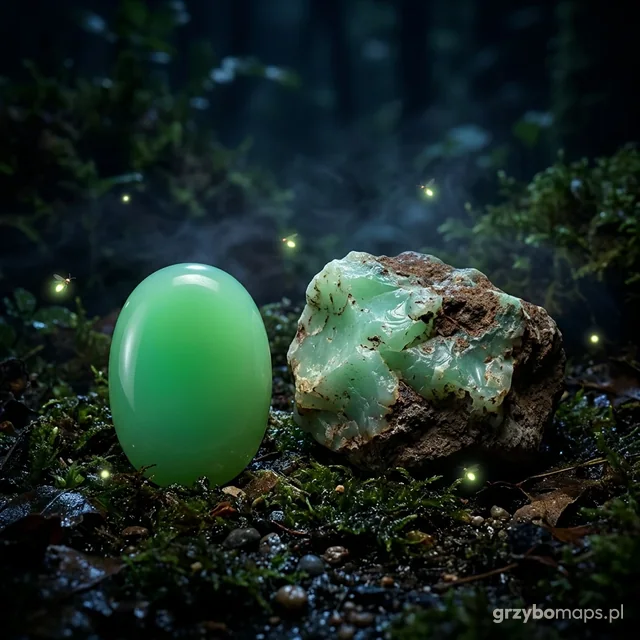
Chrysoprase
An apple-green variety of chalcedony coloured by nickel.
The only Polish chrysoprase deposits lie at Szklary near Ząbkowice Śląskie, in weathered serpentinite rich in nickel. Prized since the Middle Ages, but the best batches were extracted in the 1970s.
What it is
An apple-green variety of chalcedony (SiO2) coloured by nickel.
How to recognise
- A juicy apple green, translucent, waxy lustre.
- As hard as quartz.
- Often in veinlets in brown or greenish serpentinite weathering products.
- Nephrite is a darker green and fibrous; dyed chalcedony has an uneven colour, concentrated in the cracks.
How and where to look
On spoil heaps and in outcrops of serpentinite weathering at Szklary. Good specimens are rare today; greenish opals and chalcedonies turn up more often. The Geological and Mining Law (art. 4) does not cover obtaining specimens of minerals, rocks and fossils for collecting, scientific and educational purposes, if this is done without mining works. In nature reserves and national parks, collecting minerals and fossils is prohibited (Nature Conservation Act, art. 15). On someone else's land, in a forest and in a quarry, you need the permission of the owner, the forest district or the manager.
Known places in Poland
- Szklary, a former nickel mine (woj. dolnośląskie): The grounds of a former mine, partly with an underground educational route; collecting only with the manager's permission.
Meaning and legends
Chrysoprase from Szklary adorned the St Wenceslas Chapel in the cathedral on Hradčany Hill in Prague. People in the Middle Ages believed it brings luck and protects against evil; these are beliefs.
Fun fact
The name comes from Greek: chrysos (gold) and prason (leek), although the stone is green, not golden.