

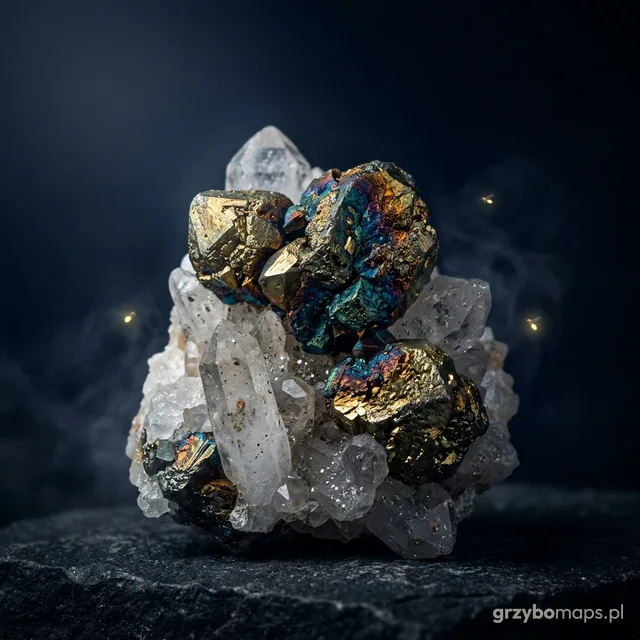
Chalcopyrite
Copper iron sulphide, the most important copper ore in the world.
Golden-yellow chalcopyrite occurs in Miedzianka in the Rudawy Janowickie and in the copper deposits of Chęciny. In the Legnica-Głogów deposit it is one of the main copper minerals.
What it is
Copper iron sulphide (CuFeS2), the most important copper ore in the world.
How to recognise
- Deep yellow, more golden than pyrite.
- Often an iridescent tarnish (green, purple).
- A knife scratches it, pyrite it does not.
- Gold is malleable, chalcopyrite is brittle with a green-black streak.
How and where to look
On the dumps of former copper mines. Specimens from KGHM mines only through exchange or a mineral fair. The Geological and Mining Law (art. 4) does not cover collecting specimens of minerals, rocks and fossils for collecting, scientific and educational purposes, as long as it is done without mining works. Collecting minerals and fossils is prohibited in nature reserves and national parks (Nature Conservation Act, art. 15). On someone else's land, in a forest and in a quarry, you need permission from the owner, the forest district or the manager.
Known places in Poland
- Miedzianka (Rudawy Janowickie) (woj. dolnośląskie): Former copper mining; dumps in the forest, with the forest district's permission.
- Góra Miedzianka near Chęciny (woj. Świętokrzyskie): Reserve: look only.
Meaning and legends
Miedzianka in the Rudawy was a mining town that vanished after the war; its history was described by Filip Springer.
Fun fact
Poland has some of the largest copper deposits in Europe, in the Lubin and Polkowice area.