

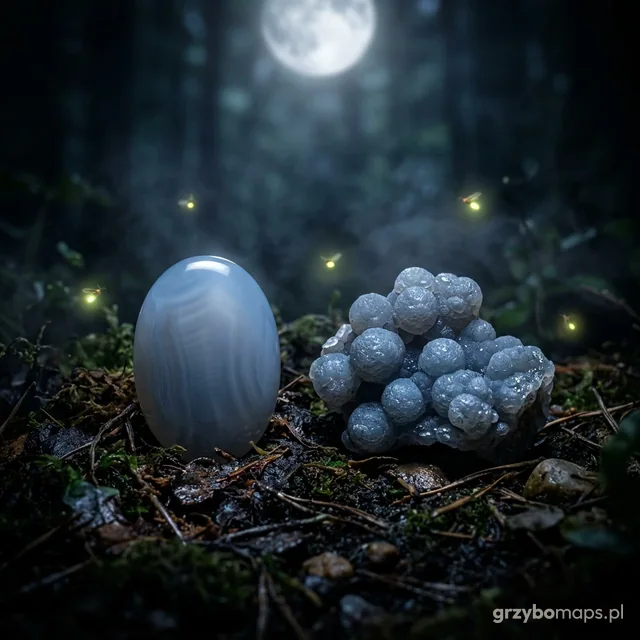
Chalcedony
Microcrystalline, fibrous silica
It is the 'material' of agates, chrysoprase and jaspers. Chalcedony on its own forms kidney-shaped crusts in cavities in lavas and veins in serpentinites in Lower Silesia.
What it is
Microcrystalline, fibrous silica (SiO2); without distinct bands, milky, bluish or grey.
How to recognise
- Translucent, milky to bluish-grey, waxy lustre.
- Often stalactitic, botryoidal shapes.
- Hard, scratches glass.
- Opal is softer and lighter; milky quartz is opaque and has no waxy lustre.
How and where to look
The same places as agates: fields and streams in areas of former lavas, spoil heaps of melaphyre quarries. The Geological and Mining Law (art. 4) does not cover obtaining specimens of minerals, rocks and fossils for collecting, scientific and educational purposes, if this is done without mining works. In nature reserves and national parks, collecting minerals and fossils is prohibited (Nature Conservation Act, art. 15). On someone else's land, in a forest and in a quarry, you need the permission of the owner, the forest district or the manager.
Known places in Poland
- Płóczki Górne (woj. dolnośląskie): Fields on Permian lavas; with the farmer's permission.
- Szklary (woj. dolnośląskie): Chalcedony with chrysoprase and opal; with the manager's permission.
Meaning and legends
The name probably comes from ancient Chalcedon on the Bosporus. Seals and cameos were cut from chalcedony; tradition ascribed to it a calming effect, which is only a belief.
Fun fact
Under a microscope chalcedony consists of very thin quartz fibres.