

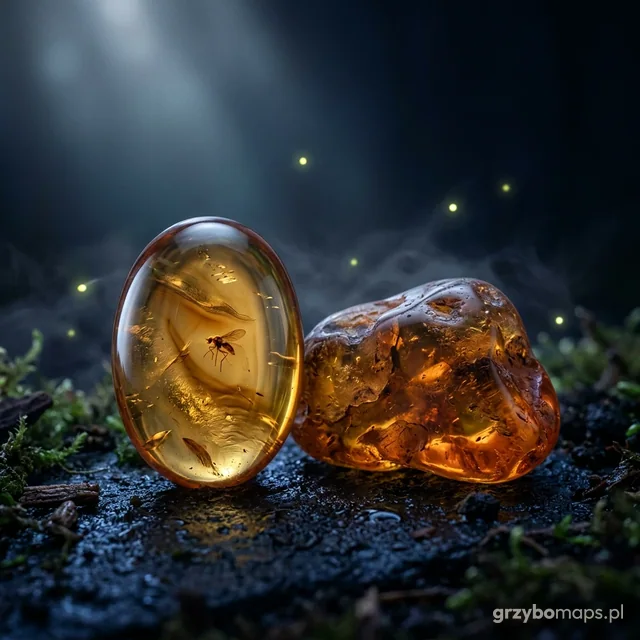
Baltic amber
Fossil conifer resin about 40 million years old, an organic substance, not a mineral in the strict sense.
The most Polish of ornamental stones. The sea throws it up on the beaches, and in Kurpie it was dug out of the ground for centuries. It is light, warm to the touch and often hides inclusions of insects or plants.
What it is
Fossil conifer resin about 40 million years old (succinite), an organic substance, not a mineral in the strict sense.
How to recognise
- Very light: it sinks in fresh water but floats in strongly salted water.
- Warm to the touch, a dull weathered crust, inside from honey-coloured to milky.
- Rubbed on wool, it attracts scraps of paper (it becomes electrically charged).
- Glass and plastic are heavier and colder; copal and fresh resins soften with a drop of acetone or alcohol, amber does not.
How and where to look
Best in winter and early spring, in the morning after a strong storm from northern directions, in the strips of washed-up seaweed and small driftwood. It is worth having a UV torch, because amber glows blue. Collecting from the beach is legal, but extracting amber from a deposit (pumping, digging) requires a concession. You must not dig in the dunes or within the territory of Słowiński or Woliński National Park. The Geological and Mining Law (art. 4) does not cover obtaining specimens of minerals, rocks and fossils for collecting, scientific and educational purposes, if this is done without mining works. In nature reserves and national parks, collecting minerals and fossils is prohibited (Nature Conservation Act, art. 15). On someone else's land, in a forest and in a quarry, you need the permission of the owner, the forest district or the manager.
Known places in Poland
- The beach at Stegna and Jantar (Vistula Spit) (woj. pomorskie): Public beach, hand collecting after a storm.
- Krynica Morska (woj. pomorskie): Public beach; part of the spit is a landscape park, digging in the dunes is not allowed.
- Kadzidło and Wach (Kurpie) (woj. mazowieckie): A tradition of Kurpie amber; in Wach there is a private museum and the Kurpie Amber Festival.
Meaning and legends
The Romans brought it along the Amber Road; Pliny the Elder described the expedition of a Roman knight who, under Nero, brought huge quantities of amber from the Baltic coast. A Greek myth said it was the congealed tears of the Heliades mourning Phaethon. In Kurpie, strings of amber beads were part of a maiden's dowry. Old beliefs attributed protective power to it; that is only tradition.
Fun fact
The ethnographer Adam Chętnik counted nearly 200 places in Kurpie where amber was dug or found in the 19th century.
Sources
Check for yourself
- Salt water. Stir about 90 g of salt (about 5 tablespoons) into 250 ml of water and keep stirring until it stops dissolving. Amber will float in it, while in ordinary water it sinks.
- A warm stone. Hold to your cheek a piece of amber, a glass bead and a pebble that have been lying in the same drawer. Amber feels the warmest, because it draws heat from the skin only weakly.
- Wool and paper. Rub the lump against a woollen sweater for 20 seconds and bring it close to scraps of tissue paper. Amber will attract them.
Did you know…
- Electricity from amber. The Greek word “elektron” meant amber. From it William Gilbert in 1600 coined the word “electricus” for attraction by rubbed bodies. Wikipedia: Electricity
- The Amber Road. Amber from the Baltic travelled south along the Amber Road, and the route became an important trade route of the Roman Empire. Wikipedia: Amber Road
- Acid from amber. Succinic acid used to be obtained by distilling amber; its name comes from the Latin succinum, meaning amber. Wikipedia: Succinic acid