

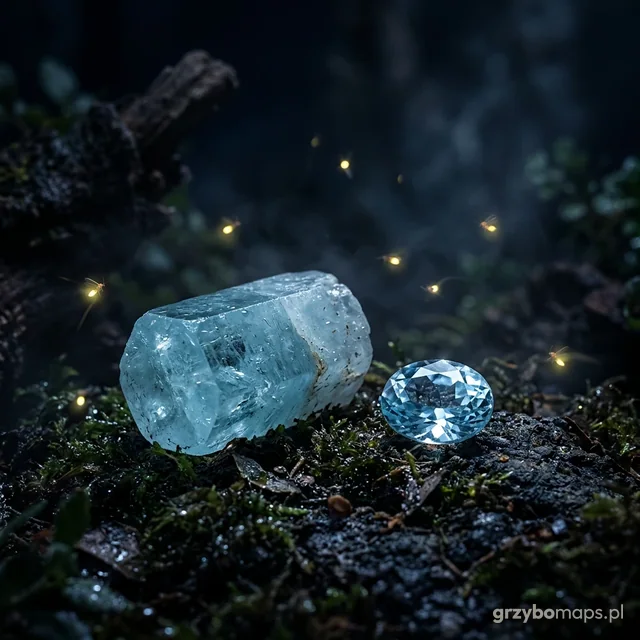
Beryl
Beryllium aluminium silicate
In Poland beryl occurs in the pegmatites of Lower Silesia, including Piława Górna and near Szklarska Poręba. They are usually milky or pale green columns, rarely of gem quality.
What it is
Beryllium aluminium silicate; the gem varieties are emerald and aquamarine.
How to recognise
- Hexagonal columns with a flat top (not with a pyramid tip like quartz).
- Pale green, bluish, yellowish or milky.
- Harder than quartz.
- Apatite also has a hexagonal cross section, but it is much softer (a knife scratches it).
How and where to look
In pegmatites on quarry dumps. Look for columns with a flat end. The Geological and Mining Law (art. 4) does not cover collecting specimens of minerals, rocks and fossils for collecting, scientific and educational purposes, as long as it is done without mining works. Collecting minerals and fossils is prohibited in nature reserves and national parks (Nature Conservation Act, art. 15). On someone else's land, in a forest and in a quarry, you need permission from the owner, the forest district or the manager.
Known places in Poland
- Piława Górna, quarry (woj. dolnośląskie): Active quarry; only with the operator's permission.
- Szklarska Poręba (woj. dolnośląskie): Pegmatites in granite; outside Karkonosze National Park.
Meaning and legends
The German word Brille (glasses) derives from beryllos, because in the Middle Ages reading lenses were ground from beryl. Lapidaries credited it with reconciling spouses; this is a belief.
Fun fact
The element beryllium was discovered in this very mineral (1798).