

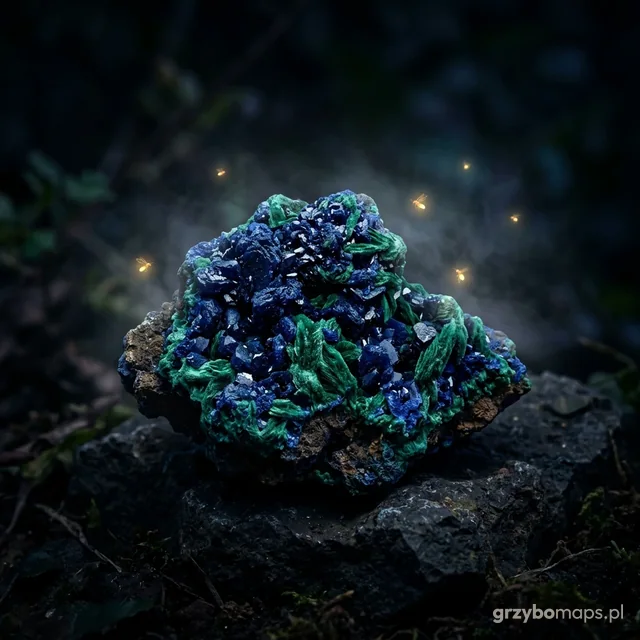
Azurite
Basic copper carbonate, the blue 'brother' of malachite.
Azurite occurs together with malachite in the oxidation zone of the copper deposits of Chęciny and the Rudawy Janowickie. It usually forms small crystals and coatings.
What it is
Basic copper carbonate (with hydroxide groups), the blue 'brother' of malachite.
How to recognise
- Deep azure blue.
- It fizzes in acid.
- Often found with green malachite.
- Lazurite (lapis lazuli) does not fizz in acid and has pyrite flecks.
How and where to look
On the dumps of former copper mines outside reserves. Protect specimens from moisture. The Geological and Mining Law (art. 4) does not cover collecting specimens of minerals, rocks and fossils for collecting, scientific and educational purposes, as long as it is done without mining works. Collecting minerals and fossils is prohibited in nature reserves and national parks (Nature Conservation Act, art. 15). On someone else's land, in a forest and in a quarry, you need permission from the owner, the forest district or the manager.
Known places in Poland
- Miedzianka near Chęciny, Teresa adit (woj. Świętokrzyskie): Reserve: look only.
Meaning and legends
As 'mountain blue', azurite was an important pigment for old masters; it was exported from Chęciny in the 16th-17th centuries. Lapidaries linked it with the sky and clarity of mind; this is a belief.
Fun fact
Over time, azurite in paintings can turn into green malachite.