

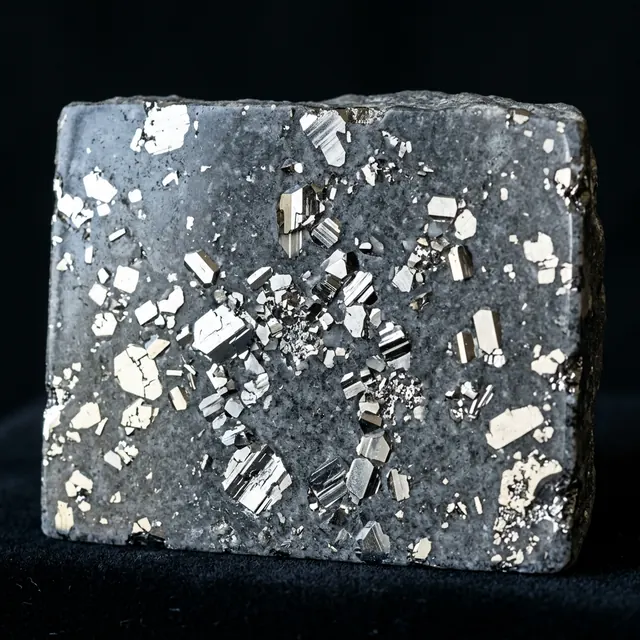
Arsenopyrite (mispickel)
Iron arsenic sulphide, FeAsS
A silvery-white to steel-grey ore with a metallic lustre, forming prismatic crystals with striations. In Złoty Stok there was gold-bearing arsenopyrite, mined from the Middle Ages until the mid-20th century. It also occurs in Czarnów and Radzimowice, among other places.
Arsenopyrite, formerly called mispickel, is the most common arsenic mineral and its most important ore. Arsenic makes up almost half of its weight. It has a Mohs hardness of 5.5 to 6. In Poland it is best known from Złoty Stok, where gold and later arsenic were extracted from it for centuries. Today the old mine can be visited on a guided tour.
What it is
Iron arsenic sulphide, FeAsS; the most important ore of arsenic, often containing admixtures of gold.
How to recognise
- Tin-white or steel-grey, metallic lustre, streak dark grey to almost black.
- Heavy (density 5.9-6.2 g/cm3), brittle, prismatic crystals with striations.
- Struck with a hammer it gives off sparks and releases the garlic smell of arsenic compounds.
- Pyrite is brassy yellow and marcasite is greenish yellow; arsenopyrite is tin-white.
How and where to look
It contains arsenic, which is strongly poisonous. Do not lick or sniff specimens up close, do not heat them, do not crush them in an enclosed space. Wash your hands after touching, and keep specimens in a closed, labelled box away from children and food. Old adits risk collapse and may have bad air. Geological and mining law (art. 4) does not cover the collecting of specimens of minerals, rocks and fossils for collecting, scientific and teaching purposes, if it is done without mining works. In nature reserves and national parks, collecting minerals and fossils is forbidden (Nature Conservation Act, art. 15). On someone else's land, in a forest and in a quarry, the permission of the owner, the forest district or the manager is required.
Known places in Poland
- Gold Mine in Złoty Stok (woj. dolnośląskie): A tourist route in the former gold and arsenic mine (ul. Złota 7) with a mineral exhibition; underground, keep to the route and do not collect specimens.
- Czarnów (Rudawy Janowickie) (woj. dolnośląskie): Former mining workings; do not enter the old adits, view the spoil heaps only with the permission of the landowner.
Meaning and legends
Złoty Stok (formerly Reichenstein) was for centuries a centre of gold and arsenic mining. In 1907 an electric railway to carry away the ore was put into operation here. The mineral's name comes from its chemical composition (E. F. Glocker, 1847).
Fun fact
The mine in Złoty Stok was closed in 1961, and since 1996 a tourist route has operated in it, with an underground waterfall and a boat ride.
Frequently asked questions
Is arsenopyrite dangerous?
A specimen kept in a closed box is not dangerous, but arsenopyrite contains arsenic. Dust, heating and the weathered surface of the mineral are harmful, so do not grind it, heat it or lick it, and wash your hands every time you touch it.
How do you tell arsenopyrite from pyrite?
Pyrite is brassy yellow and often forms cubic crystals. Arsenopyrite is silvery white like tin, and its crystals are prismatic and striated. When struck with a hammer, arsenopyrite gives off a garlic smell.
Where in Poland can you find arsenopyrite?
Above all in Złoty Stok in the Golden Mountains (Góry Złote), and also in Czarnów in the Rudawy Janowickie and in Radzimowice in the Kaczawskie Mountains. The easiest places to look are old spoil heaps, but collecting minerals is forbidden in nature reserves and national parks.
What is arsenopyrite used for?
It was the main source of arsenic, used to make white arsenic, pesticides and pigments. It also often contains tiny grains of gold, which is why it was mined as gold ore in Złoty Stok.