

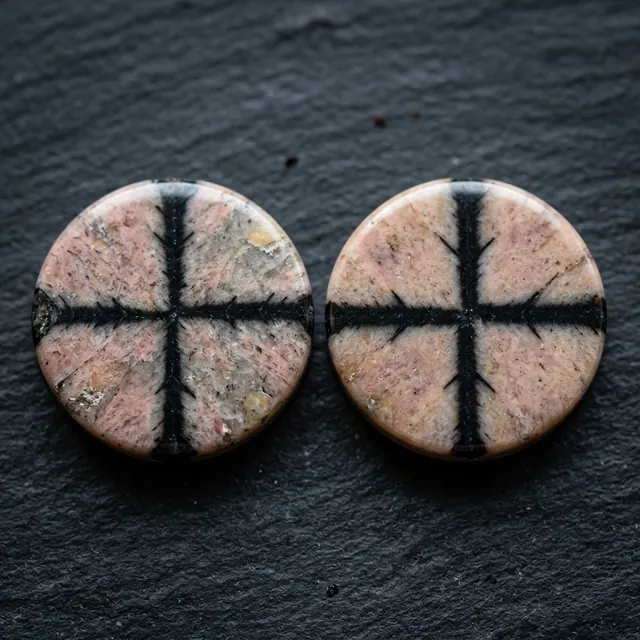
Andalusite (chiastolite)
Aluminium silicate Al2O[SiO4] from metamorphic rocks
It forms in clay slates transformed into hornfels next to granite intrusions. It forms elongated crystals up to about 20 cm. In Poland it is found in Lower Silesia: in the Karkonosze massif, in the Strzegom-Sobótka massif and in the Góry Sowie.
What it is
Aluminium silicate Al2O[SiO4] from metamorphic rocks; the variety chiastolite has a dark cross of carbonaceous material in the centre.
How to recognise
- Elongated, prismatic or rod-like crystals, most often light grey with a pinkish or reddish tint.
- In cross-section, chiastolite shows a black cross or hourglass.
- Strong pleochroism: when turned, the stone changes shade (yellow, green, reddish).
- It does not dissolve in acids and does not melt; it scratches glass.
How and where to look
Look in dark, hard hornfels near granite, in pegmatite veins and among pebbles. In the Karkonosze National Park collecting is forbidden. Geological and mining law (art. 4) does not cover the collecting of specimens of minerals, rocks and fossils for collecting, scientific and teaching purposes, if it is done without mining works. In nature reserves and national parks, collecting minerals and fossils is forbidden (Nature Conservation Act, art. 15). On someone else's land, in a forest and in a quarry, the permission of the owner, the forest district or the manager is required.
Known places in Poland
- Bielawa (Góry Sowie) (woj. dolnośląskie): Góry Sowie; in the forest, the permission of the forest district is required, in nature reserves collecting is forbidden.
- Strzegom (Strzegom-Sobótka massif) (woj. dolnośląskie): Active granite quarries are private; entry only with permission.
- PAN Museum of the Earth, Warsaw (woj. mazowieckie): Mineral and rock specimens from Poland in the museum's collections.
Meaning and legends
The mineral's name comes from Andalusia in Spain, and chiastolite from the Greek chiasmos, meaning crossed. Souvenirs for pilgrims were made from chiastolite from the Santiago de Compostela area; the sign of the cross in the stone was considered miraculous, which is a belief, not a fact.
Fun fact
Andalusite, kyanite and sillimanite have the same chemical composition, but differ in crystal structure (they are polymorphs).