

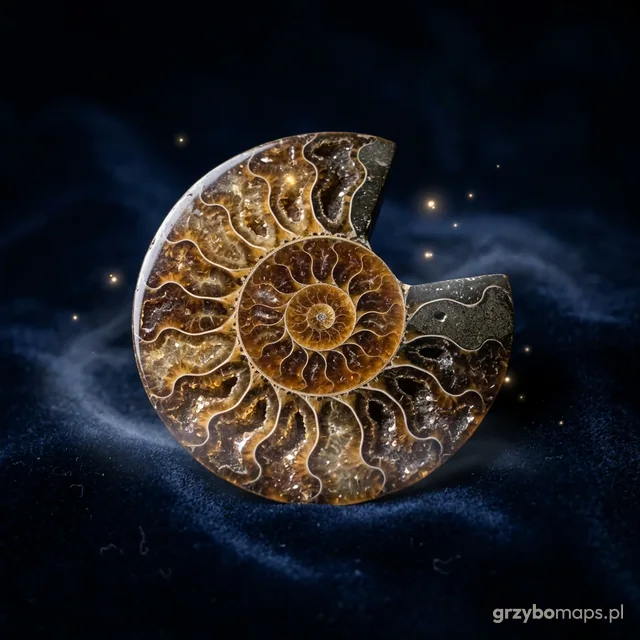
Ammonite
The fossilised, spiral shell of an extinct cephalopod
Ammonites are abundant in Jurassic rocks, including on the Kraków Jura. Those from Łuków are also famous, where a glacier dragged in a raft of Jurassic clays with Quenstedtoceras ammonites.
What it is
The fossilised, spiral shell of an extinct cephalopod; the shell was made of aragonite and in the fossil is often replaced by calcite, pyrite or clay.
How to recognise
- A flat spiral with ribs, from a few mm to several dozen cm.
- On a broken or polished surface you can see the septa and a winding suture line.
- Often soft and reacting with acid; sometimes it shines like gold when replaced by pyrite.
- Snails have a raised spiral, not a flat one, and have no septa.
How and where to look
Look in the spoil heaps of Jurassic clays and limestones, in old quarries in the Jura. Always ask the manager for permission; fossils in reserves and documentation sites are protected. The Geological and Mining Law (art. 4) does not cover obtaining specimens of minerals, rocks and fossils for collecting, scientific and educational purposes, if this is done without mining works. In nature reserves and national parks, collecting minerals and fossils is prohibited (Nature Conservation Act, art. 15). On someone else's land, in a forest and in a quarry, you need the permission of the owner, the forest district or the manager.
Known places in Poland
- Kra Jurajska reserve, Gołaszyn near Łuków (woj. lubelskie): A reserve (1980) on a raft of Jurassic clays: collecting is forbidden. The old brickworks at Łapiguz is flooded today.
- Zalas near Krzeszowice (woj. małopolskie): A quarry with Jurassic fauna; it is the site of a company, entry only with permission.
Meaning and legends
Pliny called them 'horns of Ammon', because they resembled the horns of the Egyptian god. In England they spoke of 'snakestones', turned to stone by Saint Hilda. These are legends.
Fun fact
The ammonites from near Łuków have kept their original nacreous aragonite shell, although they are about 160 million years old.