

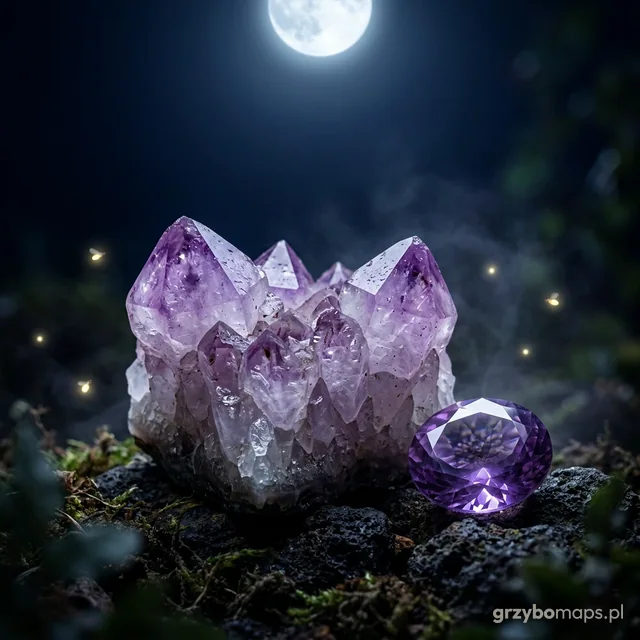
Amethyst
A violet variety of quartz
In Poland amethyst occurs mainly in Lower Silesia: in the Karkonosze, the Śnieżnik Massif, the Kaczawskie Mountains and the Intra-Sudetic Basin. The crystals are usually small and pale violet, but can be very beautiful.
What it is
A violet variety of quartz (SiO2); the colour comes from iron impurities and natural radiation.
How to recognise
- Hexagonal crystals ending in a small pyramid, violet, often only at the tips.
- Hard as quartz: it scratches glass.
- Fluorite is sometimes violet too, but it is soft (a knife scratches it) and cleaves into flat faces.
- Coloured glass has bubbles and no crystal shape.
How and where to look
Look in quartz fragments on the spoil heaps of old mines, in quartz veins and in fields on Permian rocks. Crystals hide in cracks and druses. The Geological and Mining Law (art. 4) does not cover obtaining specimens of minerals, rocks and fossils for collecting, scientific and educational purposes, if this is done without mining works. In nature reserves and national parks, collecting minerals and fossils is prohibited (Nature Conservation Act, art. 15). On someone else's land, in a forest and in a quarry, you need the permission of the owner, the forest district or the manager.
Known places in Poland
- Kletno (Śnieżnik Massif) (woj. dolnośląskie): Amethyst can be seen on the underground route of a former uranium mine; spoil heaps in the surroundings, and the Bear Cave next door is a nature reserve.
- Kwietniki (Paszowice commune) (woj. dolnośląskie): Amethyst fragments in Permian conglomerates in the fields; only with the owner's permission.
Meaning and legends
The Greek name amethystos means 'not intoxicated'; the ancients believed it protects against drunkenness. In the Middle Ages it adorned bishops' rings as the stone of humility. These are beliefs and symbolism.
Fun fact
A mineral new to science, bohdanowiczite, was described from Kletno.