

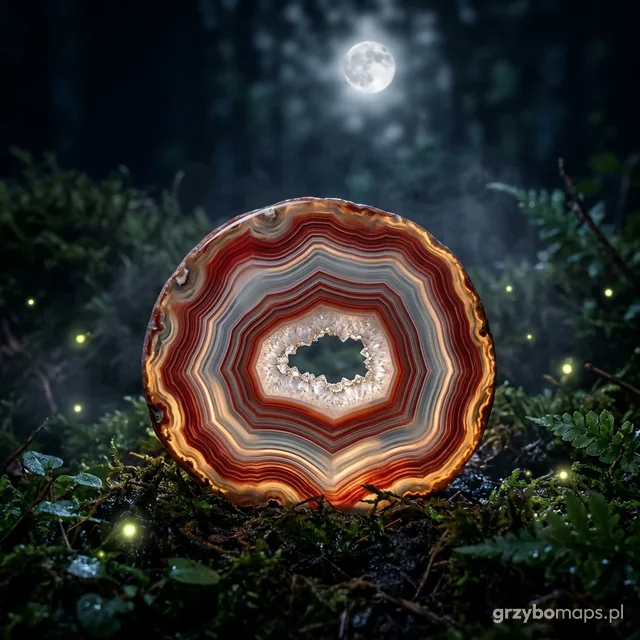
Agate
A banded variety of chalcedony, that is microcrystalline silica, filling the vesicles in ancient lavas.
Lower Silesia is one of the most interesting places in Europe for agates. They form in the cavities of Permian lavas (melaphyres) and, after those weather away, lie in the fields. From the outside they are unassuming nodules; the beauty shows only after cutting.
What it is
A banded variety of chalcedony, that is microcrystalline silica (SiO2), filling the vesicles in ancient lavas.
How to recognise
- Spherical or almond-shaped nodules (amygdales) from the size of a nut to a fist, with a rough, often greenish rind.
- On a broken surface you can see concentric bands, sometimes a cavity with quartz crystals.
- Hard: it scratches glass, and a knife cannot scratch it.
- Flint has bands less often and lacks the spherical shape; jasper is opaque and has no concentric bands.
How and where to look
Look in ploughed fields after rain in spring and autumn, in streams and on the spoil heaps of old melaphyre quarries. A geological hammer and safety glasses help. The Geological and Mining Law (art. 4) does not cover obtaining specimens of minerals, rocks and fossils for collecting, scientific and educational purposes, if this is done without mining works. In nature reserves and national parks, collecting minerals and fossils is prohibited (Nature Conservation Act, art. 15). On someone else's land, in a forest and in a quarry, you need the permission of the owner, the forest district or the manager.
Known places in Poland
- Płóczki Górne near Lwówek Śląski (woj. dolnośląskie): A famous agate field on Permian lavas; these are farmland, enter only with the farmer's permission and outside the growing season.
- Nowy Kościół (Kaczawskie Foothills) (woj. dolnośląskie): A site with agates in melaphyres; old quarries and fields, ask for permission.
- Lwówek Śląski (woj. dolnośląskie): Every year the Lwówek Agate Summer with a mineral fair and trips.
Meaning and legends
Pliny the Elder wrote that the name comes from the river Achates in Sicily, where it was first found. Medieval lapidaries ascribed to agate protection against storms and venom, and the ancients believed it quenches thirst; these are beliefs, not facts.
Fun fact
In Płóczki Górne you can come across green quartz, prasiolite, very rare in nature.