

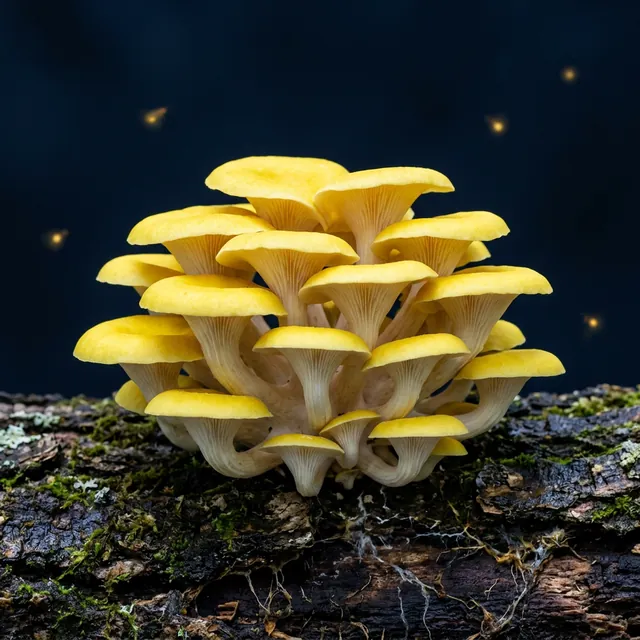
Lemon oyster mushroom
Pleurotus citrinopileatus
Polish folk names: boczniak złoty, golden oyster
How to recognise
- Caps 2–6 cm, funnel-shaped, bright lemon yellow, fading with age.
- Grows in dense clusters in which the stems fuse at the base.
- Gills white, crowded, running far down the stem.
- Flesh thin, white, brittle, with a faintly mealy smell.
Where and when it grows
It comes from the Far East, where it grows on dead trunks of elms and other broadleaf trees. In Poland it is known from farms. In the USA it escaped from cultivation and has gone wild in forests, displacing native fungi.
JanFebMarAprMayJunJulAugSepOctNovDec
Most often under: dead hardwood; in Poland only from cultivation.
Beware of the lookalike
Sulphur tuft. Sulphur tuft also grows in clusters on wood and is yellow, but it is poisonous. Its gills are greenish-yellow, later olive-black, and it tastes bitter. The lemon oyster mushroom has white gills that run down the stem. Do not pick wild yellow clusters from a trunk.
In the kitchen
Briefly fried in butter, ideally on its own so it doesn't lose its colour. It has a delicate, slightly nutty flavour. With long stewing it turns stringy.
Good to know
In Poland it isn't gathered in the forest, only bought or grown from ready-made kits. It is delicate and spoils quickly, so eat it within two to three days.
Frequently asked questions
Is lemon oyster mushroom edible?
Yes, lemon oyster mushroom is an edible mushroom.
Lemon oyster mushroom: what is it easily confused with?
Most often with the species Sulphur tuft. Sulphur tuft also grows in clusters on wood and is yellow, but it is poisonous. Its gills are greenish-yellow, later olive-black, and it tastes bitter. The lemon oyster mushroom has white gills that run down the stem. Do not pick wild yellow clusters from a trunk.