

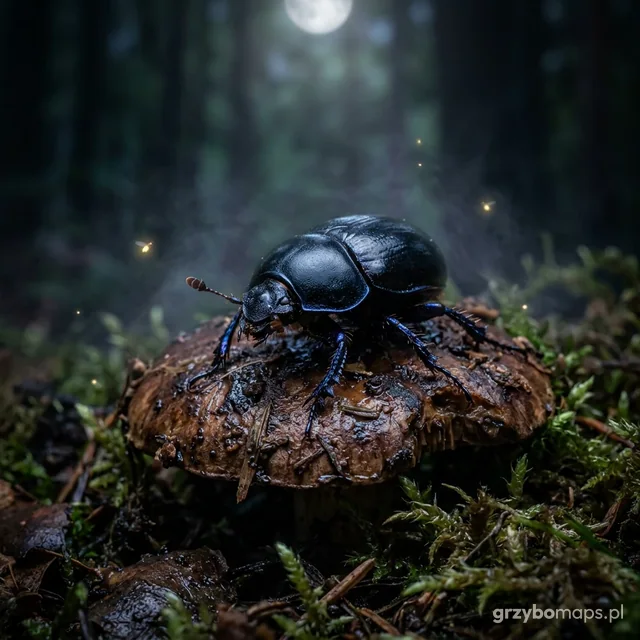
Dor beetle
Anoplotrupes stercorosus
The most common dung beetle in Polish forests, black with a navy-violet sheen on the underside. Adults eat decaying plant remains, dung and old mushroom fruiting bodies. It digs tunnels in the ground in which it leaves litter for its larvae.
How to recognise
- Length 1.2 to 2 cm, stocky and convex
- Black on top, underside with a metallic blue or violet sheen
- Often found on forest tracks
- Often has tiny mites on its body
Where it lives
Deciduous and mixed forests throughout Poland, preferring older and denser stands.
When you'll see it
From April to October, most numerous in June and September.
Tracks
Small mounds of soil by burrow holes on forest tracks. Eaten-out, decaying mushroom caps.
Tracks
Close-up of a small mound of fresh soil next to a burrow hole on a forest dirt track, with a half-eaten rotting mushroom nearby, realistic.
When you meet it
Completely harmless. If it is lying on its back on the path, you can gently turn it over.
Role in the forest
A cleaner of the forest floor: it buries litter and dung, enriches the soil and improves its aeration. It eats old, decaying mushrooms, helping the cycling of matter.
Fun fact
The main tunnel, which the male and female dig together, reaches 30 to 40 cm into the ground. The mites on its body are passengers that travel on it to new places.