

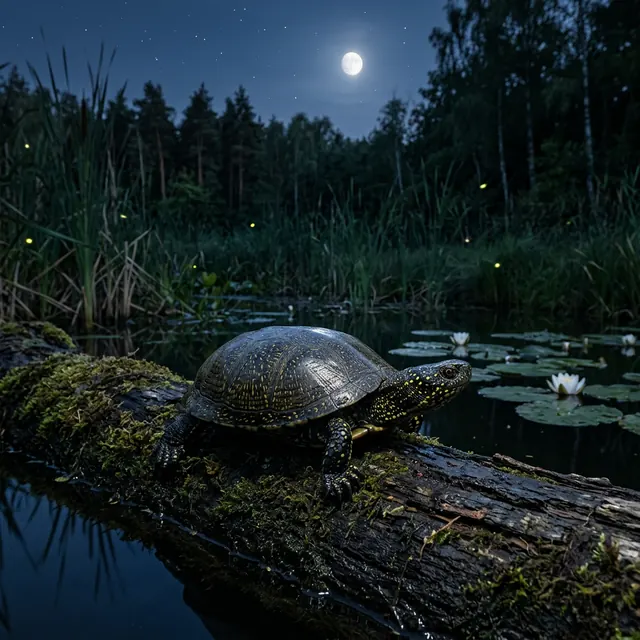
European pond turtle
Emys orbicularis
The only turtle living naturally in Poland. It has a dark, olive-brown shell with radiating yellow lines and yellow dots on the head and legs. In the wild it lives for several decades. It is very shy and hard to see.
How to recognise
- shell 14–19 cm, dark, smooth, with yellow lines and dots
- head and legs dark with fine yellow flecks
- toes webbed, with long claws
- basks on logs and jumps into the water at once
Where it lives
In isolated patches, mainly in Polesie Lubelskie, Mazowsze and western Poland. Overgrowing small lakes, bogs, oxbow lakes and woodland ponds with sandy, sunny hills nearby.
When you'll see it
From April to October. Females come onto land to lay eggs at the turn of May and June, when the yellow iris blooms. Hibernates in the mud on the bottom for about 5 months.
Tracks
Camouflaged nests in dry, sunny sand, sometimes several km from the water. Nests dug up by foxes or wild boar show white eggshells about 2 by 3 cm.
When you meet it
Do not take it home or move it to another body of water. Do not approach a female digging a nest. Every sighting is worth reporting to the regional directorate for environmental protection (RDOŚ). Do not release farmed or pet turtles into the water, because they spread diseases and compete with it.
What it is easily mistaken for
With the red-eared slider and other farmed turtles that people release into ponds. The red-eared slider has a red or yellow patch behind the eye and stripes on the neck, while the European pond turtle has a dark shell with fine yellow lines and yellow dots on the head. Alien turtles are an invasive species and must not be released.
Fun fact
The sex of young turtles is decided by the temperature in the nest while the eggs develop. The hatchlings weigh a few grams, measure about 2.5 cm and have a soft shell that only hardens after about 6 years.