

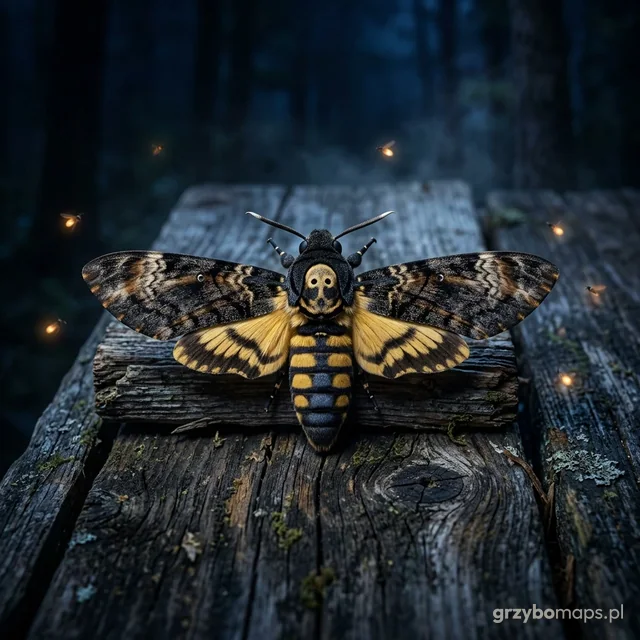
Death's-head hawkmoth
Acherontia atropos
The largest moth to visit Poland, with a skull-like pattern on its back. It arrives from southern Europe and Africa; here it is rare and does not overwinter. It can squeak and sneak into beehives for honey.
How to recognise
- Wingspan 9 to 13 cm
- A yellow pattern on the thorax resembling a human skull
- Hindwings yellow with black stripes
- Makes a squeaky sound when disturbed
Where it lives
Potato fields, gardens, forest edges, the surroundings of apiaries. Comes to light.
When you'll see it
Migrants from May to October, most often in late summer.
Tracks
Large yellow-green caterpillars with diagonal blue stripes on potato leaves and other nightshades.
Tracks
Close-up of a large yellow-green death's-head hawkmoth caterpillar with diagonal blue stripes and curved tail horn on a potato plant leaf, realistic.
When you meet it
Harmless. A rare sighting; worth taking a photo and reporting it to entomologists.
Role in the forest
A pollinator of night-blooming flowers, food for bats and owls.
What the beliefs say
The skull pattern and the squeak made people in Europe regard it as a herald of misfortune and death. That is a superstition: the moth is harmless.
Fun fact
The squeak is made when the moth pushes air out through its proboscis. In the hive it is helped by a scent similar to that of bees and by a thick armour.