

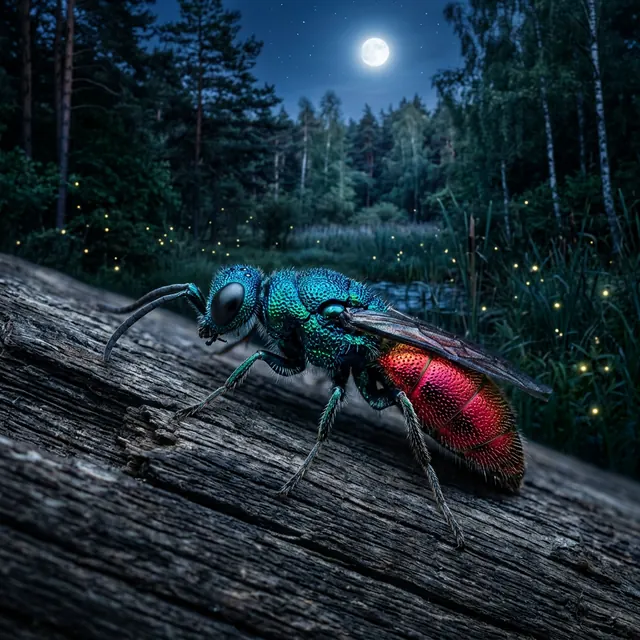
Ruby-tailed wasp
Chrysis ignita
A small, metallic-gleaming wasp, one of the most common cuckoo wasps. It does not build its own nest. The female lays eggs in the nests of solitary bees and wasps, including the red mason bee. Its larva eats the host's larva and the food the host has stored.
How to recognise
- Body armour densely and deeply punctured
- Head and thorax metallic blue-green
- Abdomen ruby-red, shining like a gem
- When disturbed it curls into a ball
Where it lives
Sunny walls, banks, quarries, dead wood and insect houses, everywhere that bees and solitary wasps nest.
When you'll see it
On sunny days, at the same time as solitary bees and wasps build their nests.
Tracks
Shining insects running nervously over a wall or insect house and peering into nest holes.
Tracks
Close-up of a ruby-tailed cuckoo wasp curled into a tight shiny ball showing only its armoured metallic back, lying on a wooden bee hotel next to reed tubes, realistic macro. Realistic nature photograph, no people, no text, square composition.
When you meet it
You can watch her from close up. Her sting has turned into a long, telescopic ovipositor for laying eggs. Do not remove her from the insect house, because she belongs to the natural balance.
Role in the forest
A parasite of bees and solitary wasps. It limits their numbers and is part of the web of dependencies in every healthy garden.
Fun fact
When attacked by the host she curls into a ball and exposes a hard little armour to the outside. Her larva has two strategies: either it eats the host's egg straight away, or it waits until the host's larva has grown and only then kills it.