

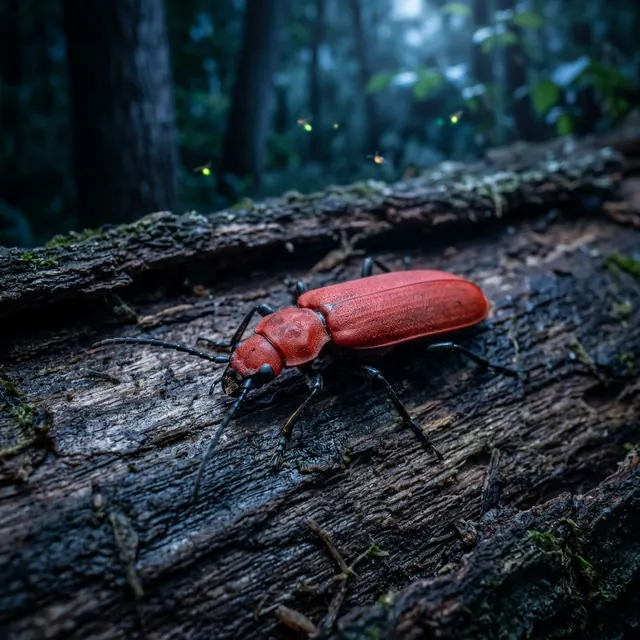
Cinnabar-red flat bark beetle
Cucujus cinnaberinus
A very flat, cinnabar-red beetle living under the bark of dead trees. Its flattened body lets it squeeze into narrow crevices. Its numbers are falling across Europe, because dead and dying trees are being removed from forests. In Poland it is under strict protection.
How to recognise
- Length 11–15 mm
- Body very flat, as if pressed
- Wing cases matt, cinnabar-red
- Large head with strong black mandibles, black antennae and legs
Where it lives
Under the bark of dead or dying poplars, oaks, maples and hornbeams, in deciduous forests, floodplain forests and even in cities.
When you'll see it
Adults active by day. Females probably lay eggs in late spring or early summer.
Tracks
Under loose bark, flat, amber-yellow, shiny larvae up to 26 mm, often in groups.
Tracks
Close-up of several flat, shiny amber-yellow beetle larvae under freshly lifted bark of a dead poplar log, realistic macro. Realistic nature photograph, no people, no text, square composition.
When you meet it
Do not tear bark off dead trees to look for it. If you see it by chance, take a photo and leave it. An observation of a protected species is worth reporting to the Regional Directorate for Environmental Protection (RDOŚ).
Role in the forest
Lives in decaying wood under the bark. It also eats the larvae of flies and other beetles.
Fun fact
An exposed beetle quickly escapes into crevices in the wood. When disturbed, it sometimes freezes, with its legs tucked under its body. Disturbed larvae sharply throw their head and front of the body from side to side.