

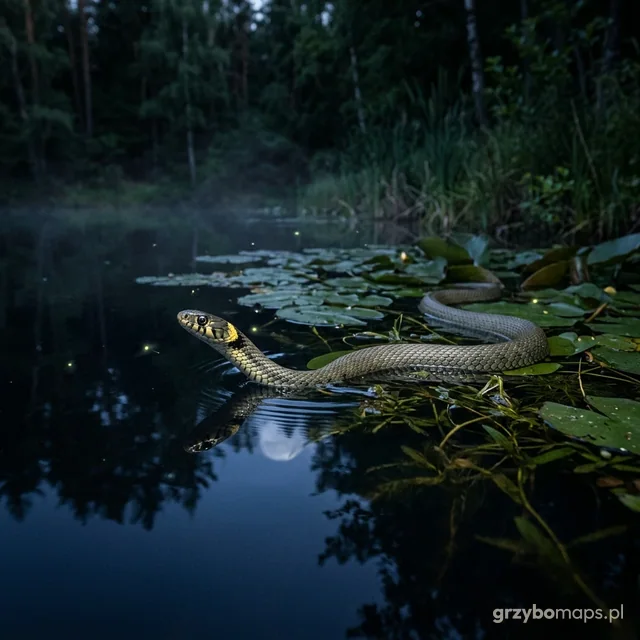
Grass snake
Natrix natrix
Poland's most common snake, completely harmless to humans. It swims very well and hunts mainly frogs and fish. When threatened it plays dead.
How to recognise
- two yellow or orange patches behind the head
- round pupil
- grey or olive, slender
- can be over 1 m long
Where it lives
All of Poland, near water: forest edges, meadows, ponds, rivers, gardens.
When you'll see it
From April to October, during the day.
Tracks
Sloughs near water. Egg clutches in compost heaps and piles of leaves.
When you meet it
Do not touch or kill it. When caught it releases a foul-smelling secretion and may play dead. Let it swim or crawl away.
What it is easily mistaken for
With the adder, especially when the patches behind the head are pale or the snake is dark. The grass snake has a round pupil, is slender and usually longer than the adder, and has no continuous zigzag on its back. Completely black grass snakes without patches turn up sometimes. If you cannot clearly see yellow patches, do not approach.
What the beliefs say
It was once believed that a snake living near cows sucks their milk and brings luck to the farm, and that killing it would harm the cow.
Fun fact
The grass snake lays its eggs in compost heaps and rotting leaves, which act as a natural incubator.