

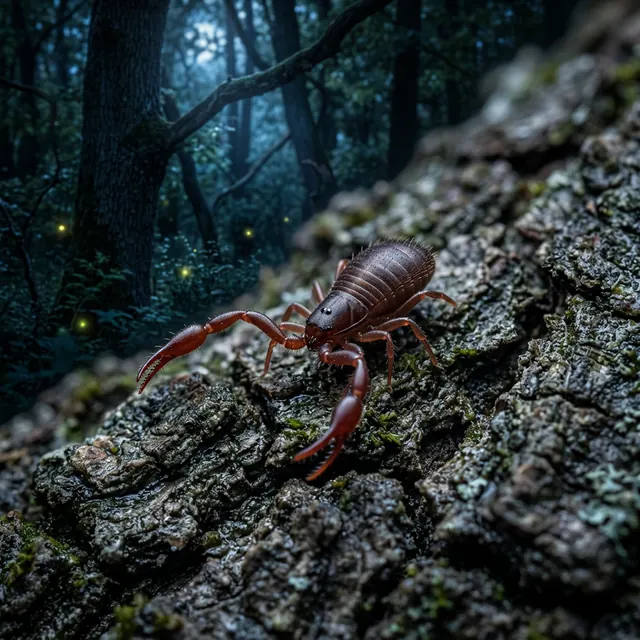
House pseudoscorpion
Chelifer cancroides
A tiny arachnid resembling a scorpion, but without a tail with a sting. It has long pincers with venom glands. It lives under loose tree bark, in bird nests, stables, houses, libraries and beehives. In Poland it is fairly common, but rarely noticed.
How to recognise
- Length 2.5–4.5 mm, drop-shaped
- Body mahogany-brown, legs reddish
- Pincers very long, 7–9 mm when spread out
- Looks like a miniature scorpion without a tail
Where it lives
Under tree bark, in tree hollows and bird nests, in beehives, barns, chicken coops and old books.
When you'll see it
All year round. Lives 3–4 years.
Tracks
No distinct traces. When moulting it builds small silk cocoons.
Tracks
Close-up of a tiny pseudoscorpion clinging with its pincers to the leg of a house fly sitting on old wood, phoresy, realistic extreme macro. Realistic nature photograph, no people, no text, square composition.
When you meet it
Harmless to humans. It is a useful lodger of the house and the hive, so do not kill it.
Role in the forest
A predator of mites and small insects. In hives it eats mites, including the varroa mite, which is dangerous to bees, and small wax moth caterpillars. In libraries it hunts paper pests.
What the beliefs say
Old hives were completely different from today's. On Polish lands, bees were kept in tree hives (barcie), that is, chambers hollowed out in living trees, and in log hives (kłody), that is, hollowed-out pieces of trunk. In the museum in Kluczbork lies an oak log hive from the 10th century, fished out of the Oder in 1901. A pseudoscorpion could live in such old hives, just as in new ones.
Fun fact
The pseudoscorpion hitchhikes. It grabs the legs of flies, hymenopterans and even bats with its pincers and flies with them to a new place. Its venom also kills bacteria, including the antibiotic-resistant Staphylococcus aureus.