

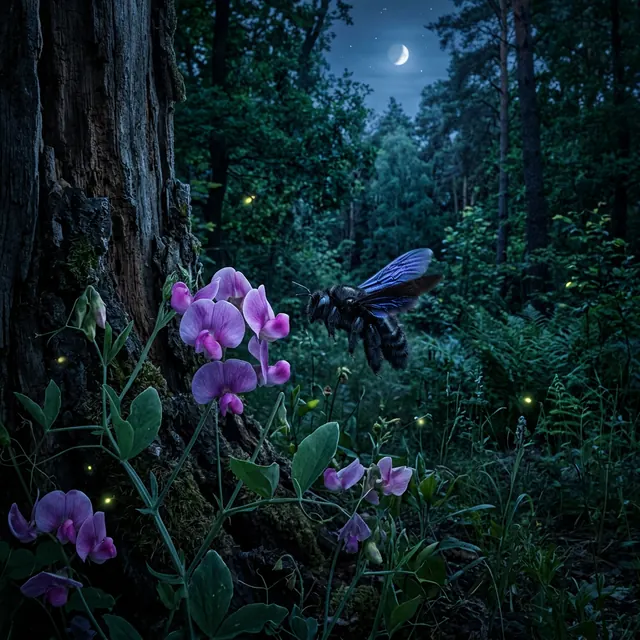
Violet carpenter bee
Xylocopa violacea
One of the largest bees in Europe, black with violet wings. The female gnaws out a nest on her own in dry, dead wood. A heat-loving insect. In Poland it was known from eight sites from the years 1868–1935, then regarded as extinct. Found again in 2005, among other places in Wrocław and in Poleski National Park.
How to recognise
- Large, 21–24 mm
- Whole body black, with black hair
- Dark wings with a violet sheen
- Buzzes loudly in flight
Where it lives
Warm, dry places: grasslands, glades, forest edges, old orchards and gardens with dead wood. In Poland rare, but recorded more and more often.
When you'll see it
From April–May to the end of summer. Adults overwinter in old tunnels in wood.
Tracks
Round holes in a dry, dead trunk or thick branch. The tunnel runs first horizontally, then downwards. In the vertical section 15–30 cm long there are about 15 cells separated by partitions of sawdust.
Tracks
Close-up of a weathered dead tree trunk with several perfectly round holes about 1.5 cm wide bored by violet carpenter bees, fresh pale sawdust below the holes, realistic macro. Realistic nature photograph, no people, no text, square composition.
When you meet it
Despite her size she is calm and attacks only when forced. Do not catch her. Leave dry trunks and branches in the garden, because they are her only place for a nest. The species is protected.
Role in the forest
A pollinator of legumes and other flowers, in Poland most often on sweet pea, black locust and viper's bugloss.
What the beliefs say
For centuries people took advantage of the fact that bees readily live in trees. In old Poland tree beekeeping (bartnictwo) flourished: bee-keepers hollowed out chambers called “barcie” in living oaks and pines, at a height of 3–12 m. Against the bear they were protected by a “samobitnia”, a heavy log hung beside the hollow. The rights of the bee-keepers were written down in the Statutes of Wiślica in 1347, and in 2020 the bee-keeping culture of Poland and Belarus was inscribed on the UNESCO list of intangible heritage.
Fun fact
After winter the young bees gnaw their way out through a new hole in the side wall of the nest. Only when the wood is too thick do they leave one after another through the hole gnawed by their mother.