

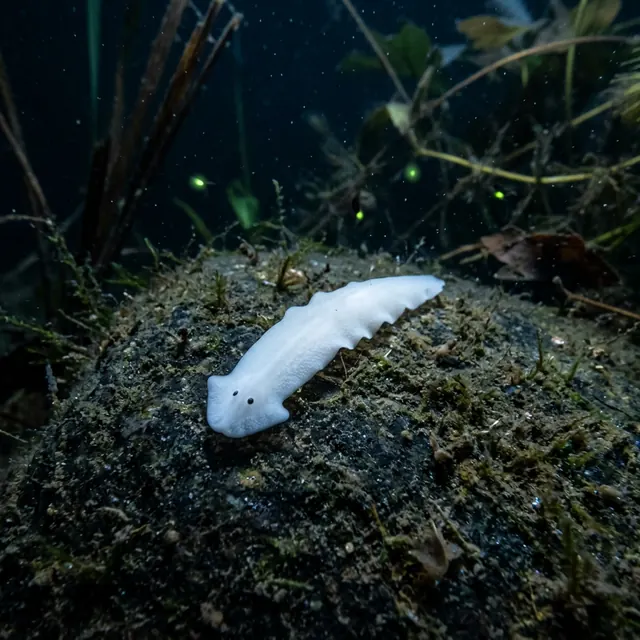
Milk-white planarian
Dendrocoelum lacteum
A milk-white freshwater flatworm. It is the most widespread planarian in Europe. It is a predator. It glides smoothly over the bottom and stones thanks to cilia and mucus. Scientists like to study planarians because they reproduce easily and have a great ability to regenerate lost body parts.
How to recognise
- Flat, length usually 1.2–2.5 cm, width up to 6 mm
- Whole body white, sometimes tinted by the food in the gut
- Two black eyespots set wide apart on the head
- Two short, blunt projections like tentacles on the sides of the head
Where it lives
Lakes, ponds and rivers throughout Europe, including Poland. Under submerged stones and fallen leaves near the shore.
When you'll see it
In the water all year round. Easiest to find by carefully turning over stones in the shallows.
Tracks
No distinct traces. A white, flat "leaf" stuck to the underside of a stone taken out of the water, which after a moment starts to crawl.
Tracks
Close-up of a wet stone lifted from a lake shore, its underside with a flat white planarian flatworm and a few water hoglouse crustaceans, realistic macro. Realistic nature photograph, no people, no text, square composition.
When you meet it
Harmless. Turn the stone over gently and put it back in the same place, the same side down.
Role in the forest
A predator of bottom invertebrates. It eats mainly water hoglice, less often scuds and oligochaete worms. It does not eat snails, so it can share a habitat with other planarians.
Fun fact
Many planarians regenerate a whole body from a small piece. The milk-white planarian is an exception: a piece from the rear half of the body cannot regrow a head and dies. In 2013, scientists from the Max Planck Institute in Dresden silenced one gene of the Wnt signalling pathway in it, and pieces of tail once again produced fully functional heads.