

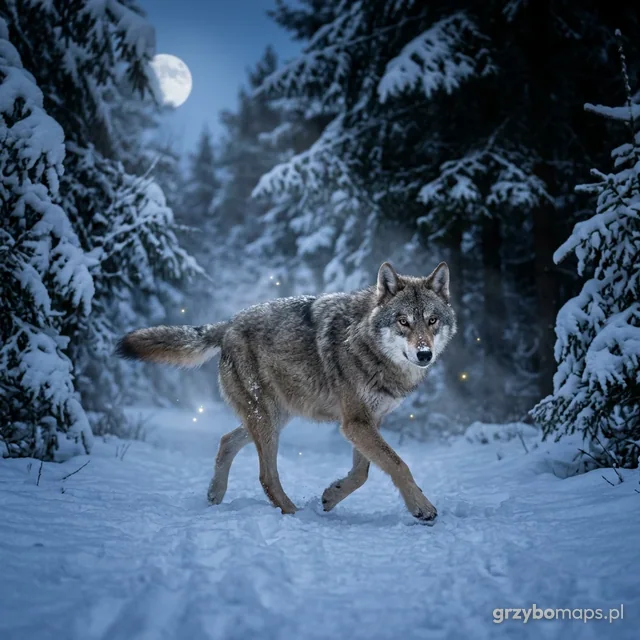
Wolf
Canis lupus
Europe's largest wild canid, it lives in family packs. It hunts mainly red deer, roe deer and wild boar, which helps keep the forest in balance. After being given protection in the 1990s it returned to many regions of Poland.
How to recognise
- similar to a large dog, but with longer legs
- grey-brown fur with a lighter muzzle
- a bushy tail carried straight
- keeps away from people
Where it lives
All of Poland, most in the east, in the Carpathians and in the west of the country. Large forest complexes.
When you'll see it
Rarely seen, active mainly at night. In winter tracks are easiest to find in the snow.
Tracks
Tracks like a large dog's, about 10 cm, set in a straight line (lacing). Droppings with fur and bones at forest road junctions.
When you meet it
Do not run and do not approach. If the wolf is close, stand up straight, speak loudly and firmly, wave your arms and slowly back away. Always keep your dog on a lead. Do not leave food in the forest and never feed wolves. It is worth reporting the encounter to the Regional Directorate for Environmental Protection (RDOŚ).
What the beliefs say
In the folk tradition of the Slavs, St. Nicholas was both a vanquisher and a protector of wolves. According to a Polish legend, a tamed wolf accompanied Our Lady of the Candles on February nights.
Fun fact
Wolf packs travel even several dozen kilometres in one night.