

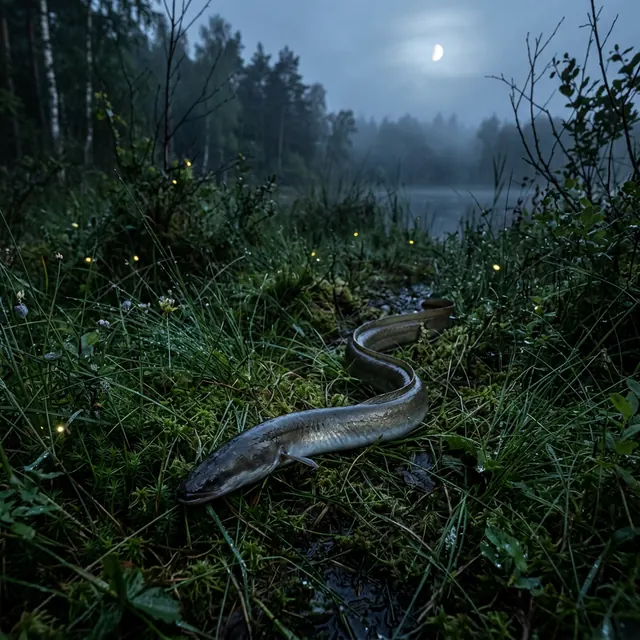
European eel
Anguilla anguilla
A fish with an extraordinary life. It is born in the Sargasso Sea near Bermuda, drifts with the currents to Europe as a transparent larva, and then lives for years in Polish rivers and lakes. At the end it returns thousands of kilometres to the Sargasso Sea, where it spawns and dies.
How to recognise
- snake-like, long body
- dorsal, caudal and anal fins fused into one
- tiny scales hidden in thick, slippery skin
- before the spawning migration the back darkens and the sides turn silver
Where it lives
Rivers, lakes and lagoons all over Poland connected to the Baltic, as well as reservoirs into which eels were stocked.
When you'll see it
Active at night, from spring to autumn. The spawning migration lasts from summer to late autumn.
Tracks
Sometimes on damp nights an eel crawls across wet grass and moss between bodies of water at a speed of about 3 km/h.
When you meet it
The eel is critically endangered, so it is best to release one you have caught. A closed season and minimum size apply to it. Do not move eels between bodies of water.
What the beliefs say
For thousands of years nobody knew where eels come from. Aristotle thought they are born from mud, from the interior of damp earth. The young Sigmund Freud searched in vain for their reproductive organs, and the spawning grounds in the Sargasso Sea were discovered only in the 20th century.
Fun fact
The development of the eel has five stages: a transparent leaf-shaped larva, glass eel, elver, yellow eel and silver eel. A Swedish eel from Brantevik reportedly survived 155 years in a well.