

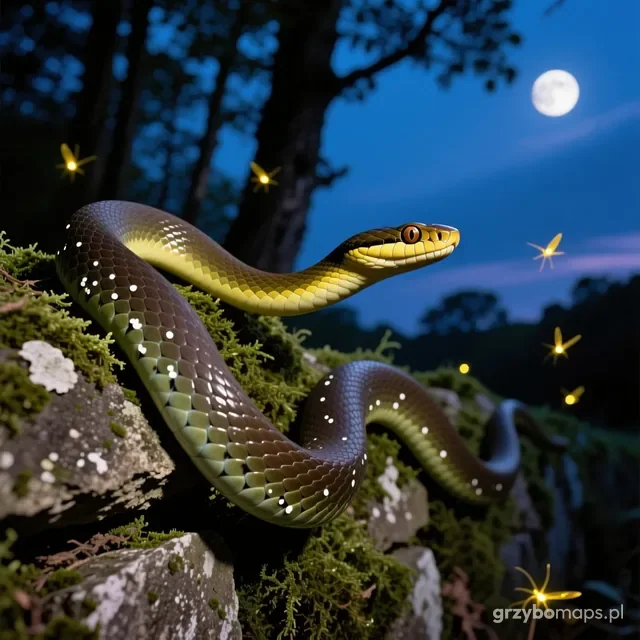
Aesculapian snake
Zamenis longissimus
The largest snake in Poland and Central Europe, it can exceed 2 m. It is non-venomous. It climbs superbly thanks to the scutes on its belly and can slither up a tree or onto the roof of a building. The Polish population is estimated at a little over 100 individuals.
How to recognise
- very long and slender, usually 1–1.6 m
- olive-brown, with tiny light flecks on the scales
- belly straw-yellow
- front part of the body lighter than the rear
- round pupil
Where it lives
Only the Bieszczady, mainly the Otryt range and surroundings, including the Krywe reserve, up to about 650–700 m above sea level. Sunny slopes, glades, river valleys, forest edges and the surroundings of abandoned buildings.
When you'll see it
From April to the turn of September and October. In hot weather active at dusk and at night.
Tracks
It lays its eggs in warm, damp places: in mould, heaps of sawdust, haystacks. Sloughed skins on rocks and by woodpiles.
When you meet it
Do not catch or kill it; it is one of the rarest reptiles in Poland. Watch from a distance. Do not disturb heaps of sawdust, hay and stones in the Bieszczady, because eggs may be laid in them. A sighting is worth reporting to the Bieszczady National Park or RDOŚ.
What it is easily mistaken for
With the grass snake and, because of its length, with nothing else in Poland. The Aesculapian snake has no yellow patches behind the head, is uniformly olive-brown with small pale dots, and has a straw-yellow belly. Young ones have spots on the back and yellowish patches on the nape, so they are easily mistaken for a young grass snake.
What the beliefs say
The Aesculapian snake is linked to the staff of Asclepius, the Roman Aesculapius, god of medicine. A snake wound around a staff is still a symbol of medicine and pharmacy today.
Fun fact
It seizes its prey in its mouth, wraps itself around it and constricts it for several minutes. In this snake, unlike most snakes, males are usually longer than females.