

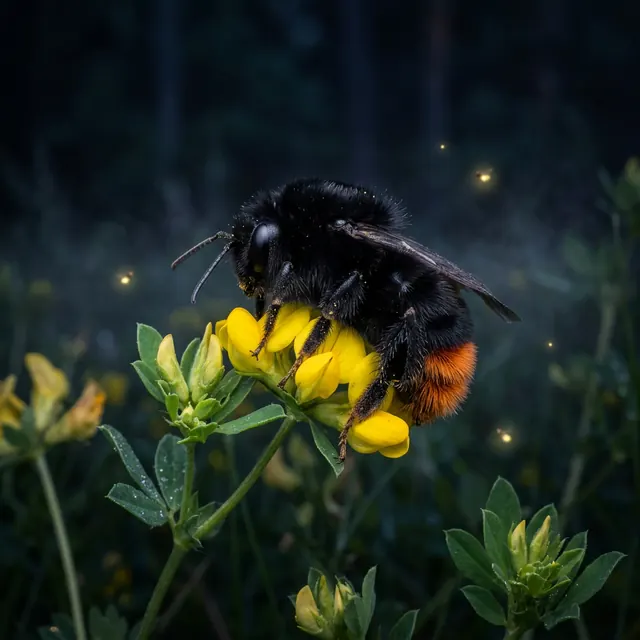
Red-tailed bumblebee
Bombus lapidarius
One of the more commonly encountered bumblebees in Poland. It lives in colonies that last one season. It builds its nest in burrows of small mammals, in nest boxes or under stones, hence its Polish name. A colony usually numbers 100–200 workers, according to some sources over 500 individuals.
How to recognise
- Length 10–22 mm
- Velvety black fur and a bright reddish-orange tip of the abdomen
- The male additionally has yellow hairs on the head and front of the thorax
- Likes to land on yellow flowers
Where it lives
All of Poland. Meadows, gardens, roadsides, forest edges and stony places, more open than deep in the forest.
When you'll see it
From spring to autumn. Most workers in summer, in June, July and August.
Tracks
Nest entrance in a crevice under a stone or in an old mouse burrow. Bumblebees fly in and out at one spot.
Tracks
Close-up of a bumblebee nest entrance in a gap under a flat mossy stone at the edge of a meadow, a red-tailed bumblebee (Bombus lapidarius) crawling into the dark hole, realistic natural light. Realistic nature photograph, no people, no text, square composition.
When you meet it
A bumblebee on a flower is calm. Do not look into the nest and do not block the entrance, because a defended nest can end in a sting. It is best to leave a nest in the garden until autumn, when the colony dies out on its own. If you have signs of an allergy, call 112. Bumblebees are protected.
Role in the forest
An important pollinator of wild plants and crops. It uses at least 360 plant species and especially likes alliums. It can fly more than 1.5 km from the nest for food.
Fun fact
Males mark out their flight routes by scenting spots above the treetops with a scent from glands near the mandibles. The scent is characteristic of the species and attracts young queens. The bumblebee warms itself by shivering its thorax muscles and with that heat also warms the larvae in the nest.