

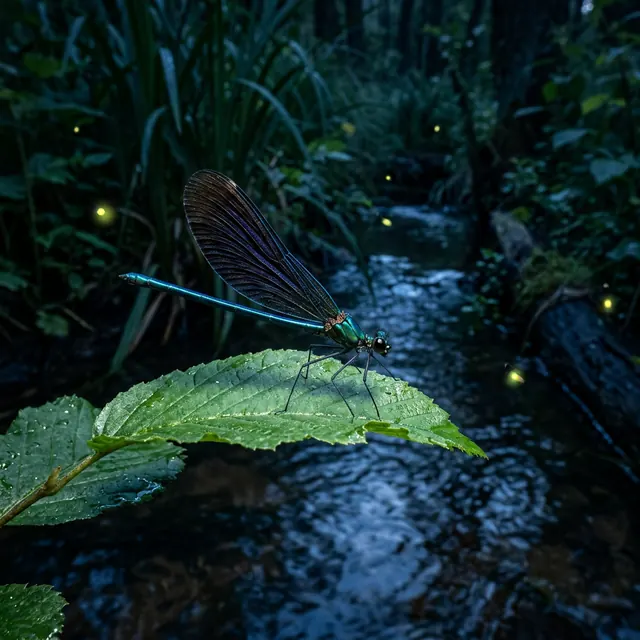
Beautiful demoiselle
Calopteryx virgo
A slender damselfly. The male shines metallic navy blue, and his dark wings gleam like silk in the sun. It likes clean, oxygen-rich waters, because its larvae take up oxygen from the water poorly and quickly die when it is lacking. In Poland it lives almost throughout the country, in the mountains up to about 1350 m above sea level.
How to recognise
- Body length 33–40 mm, wingspan about 70 mm
- Male metallic navy blue, greenish in other light
- Male's wings dark, navy-brown
- Female green, with smoky wings and a white spot near the tip of each wing
Where it lives
Clean streams and small rivers with vegetation along the banks, also in the mountains. Rare in part of central Poland.
When you'll see it
In the warm season, on sunny days over water.
Tracks
Males sitting on leaves above the water, quickly lowering and slowly raising their wings.
Tracks
Close-up of a female beautiful demoiselle with a metallic green body and smoky brown wings with a white spot near each wing tip, clinging to a plant stem at the water surface, realistic macro. Realistic nature photograph, no people, no text, square composition.
When you meet it
Harmless. Watch from the shore, without catching, because the wings are easily damaged.
Role in the forest
A predator of small flying insects. An indicator of clean, oxygen-rich waters.
What the beliefs say
Świtezianka was the name given to legendary water nymphs who, according to tales, lived in Lake Świteź, today in Belarus. Adam Mickiewicz described one of them in the 1822 ballad "Świtezianka": the nymph tests the faithfulness of a young man in love and punishes him for betrayal.
Fun fact
The female lays eggs in plant stems under water and may stay submerged for up to 90 minutes to do so. She climbs down the stem head first and pushes the eggs in with her ovipositor. Males defend territory, showing off in flight and spreading their wings.