

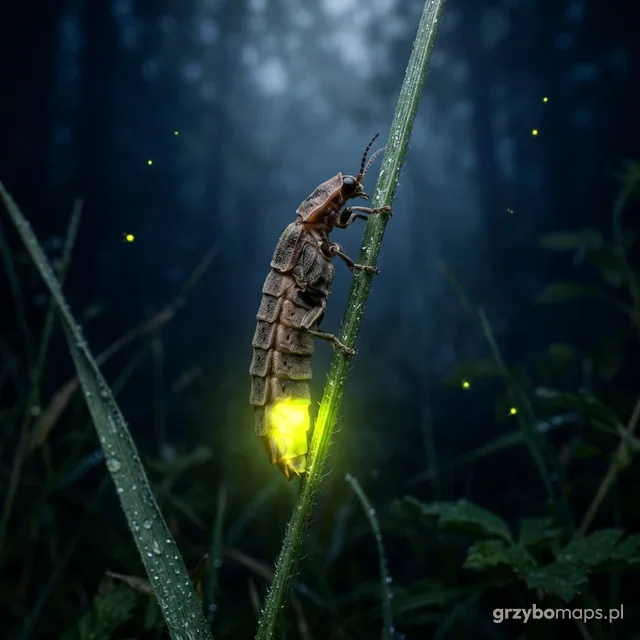
Common glow-worm
Lampyris noctiluca
A beetle that glows on June and July nights. It is mainly the wingless females that glow, sitting in the grass and luring flying males with a greenish light. Popularly called the Saint John's bug because it appears around Saint John's Night, that is Kupala Night.
How to recognise
- Female wingless, larva-like, about 1.5 to 2 cm
- Male about 1 cm, winged, with a shield covering the head
- Greenish-yellow, steady light on the underside of the tip of the female's abdomen
- Larvae black, flat, with pale spots
Where it lives
Forest edges with dense shrubs, glades, thickets, damp meadows by the forest, parks.
When you'll see it
Adults from June to July, glowing after dark.
Tracks
At night, green points of light in the grass and on low plants. By day, larvae under stones near snails.
Tracks
Night photograph of a forest edge meadow in late June with several tiny greenish glow-worm lights in dark grass, dark tree silhouettes and starry sky, realistic long exposure.
When you meet it
Harmless. Do not shine a torch on glowing females and do not take them into a jar, because you interrupt mating. Artificial light near the forest harms glow-worms badly.
Role in the forest
The larvae hunt snails, paralysing them with a secretion, including snails that eat mushrooms. Adults do not eat at all.
Fun fact
The light arises from the reaction of luciferin with oxygen, accelerated by the enzyme luciferase. It is cold light, with almost no heat. Three species of glow-worm live in Poland, and the flying little lights in the forest are often the small firefly (Lamprohiza splendidula).