

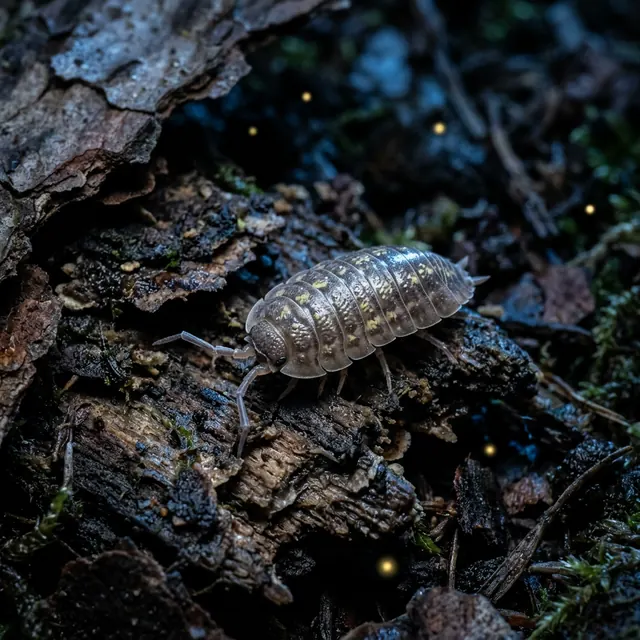
Common shiny woodlouse
Oniscus asellus
A terrestrial crustacean, a relative of crayfish and crabs. It lives only in damp places, because in the sun it dries out quickly. It eats rotting remains of plants and animals. In Poland it occurs naturally mainly on the coast and in Lower Silesia, and in the rest of the country it lives near people: in cellars, greenhouses and on walls.
How to recognise
- Length up to 16 mm, oval and flat
- Shiny grey-brown with light spots on the back
- 7 pairs of legs hidden under the shell
- Cannot roll up into a ball
Where it lives
Under loose bark, in rotting logs, under stones, on damp walls, cemeteries and ruins, in cellars and greenhouses.
When you'll see it
All year round, easiest on damp days, when it comes out onto walls.
Tracks
Moults in two parts, because the woodlouse sheds the rear and front halves of its body separately. It often eats its old skin.
Tracks
Close-up of a woodlouse halfway through moulting, the rear half pale and new, the front half still covered by the old skin, on damp bark, realistic macro. Realistic nature photograph, no people, no text, square composition.
When you meet it
Harmless to humans. In a greenhouse it can damage young plants.
Role in the forest
Breaks down dead wood, leaves and remains, turning them into humus. It is food for toads and newts.
Fun fact
The light spots on the back are stores of calcium, which the woodlouse uses to harden its new shell after moulting. Woodlice accumulate lead, copper, zinc and cadmium in their bodies, which is why scientists use them to study soil contamination with heavy metals.