

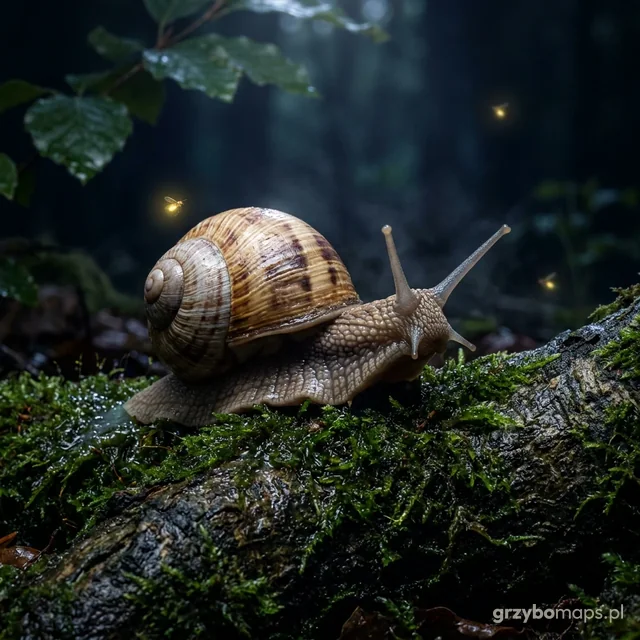
Roman snail
Helix pomatia
The largest Polish land snail, with a shell up to about 5 cm. It is partially protected: collecting is allowed only with a permit from the director of environmental protection (RDOŚ or GDOŚ), by hand, from 20 April to 31 May, and only specimens with a shell of at least 30 mm. It overwinters buried in the soil, with its shell closed by a calcareous lid.
How to recognise
- Spherical, beige-brown shell with darker bands, 3 to 5 cm
- Grey, wrinkled body
- Two pairs of tentacles, eyes at the tips of the longer ones
- A slime trail behind it
Where it lives
Deciduous forests, thickets, forest edges, parks and gardens, especially on calcium-rich soils.
When you'll see it
Active from April to October, most of all after rain and at night.
Tracks
Silvery slime trails on leaves and trunks, nibbled leaves. In winter it is buried, with a white lid on its shell.
Tracks
Close-up of a silvery glistening slime trail across a fallen beech leaf and moss, with dew, early morning light, realistic.
When you meet it
Harmless. Do not collect without a permit. Wash your hands after touching snails.
Role in the forest
Eats plants and their remains, breaks down organic matter. Food for hedgehogs, birds, shrews and glow-worm larvae.
Fun fact
The Roman snail is a hermaphrodite. During mating, the snails stab each other with calcareous love darts.