

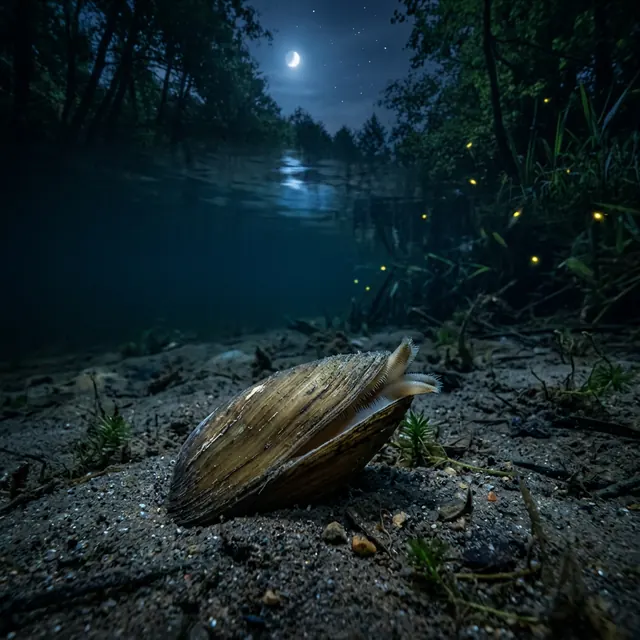
Painter's mussel
Unio pictorum
A freshwater bivalve with an elongated shell. It lives on the bottom of rivers and lakes, partly buried in mud or sand, and moves slowly. It lives 10–15 years. It occurs throughout Europe, including Poland.
How to recognise
- Shell elongated, 7–10 cm
- A bivalve: the body enclosed in two halves of a shell
- Lives on the bottom, partly buried in mud or sand
- Empty shells often lie on the shore
Where it lives
Rivers, canals and lakes with a sandy or muddy bottom.
When you'll see it
All year round. Empty shells are easiest to find on the shore after the water level drops.
Tracks
Empty shells on a river or lake shore, especially after the water level drops.
Tracks
Close-up of an empty open painter's mussel shell on a river bank, the inner surface pearly white and iridescent, with a small dab of artist's paint in one valve, realistic. Realistic nature photograph, no people, no text, square composition.
When you meet it
Do not take living mussels out of the water. Carefully put a shell with a living animal back on the bottom.
Role in the forest
The mussel's larvae, called glochidia, attach for several weeks to the gills or fins of fish and only then drop to the bottom as young mussels. This is how mussels spread along the river together with the fish.
What the beliefs say
The name comes from painters. Already in antiquity they used the shells of this mussel as handy little vessels for storing and grinding paints, especially in the tempera technique.
Fun fact
Mussels protect the young of a certain fish. The female bitterling uses her long ovipositor to place eggs inside the mussel, and the male releases milt over it. The fish larvae grow safely in the mussel's gills for about 14 days.