

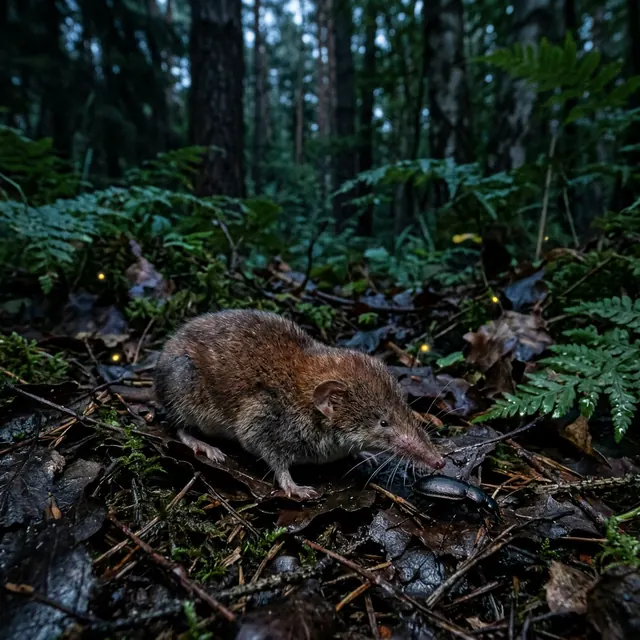
Common shrew
Sorex araneus
A small insect-eating mammal with a long, mobile snout. Its metabolism is so fast that it eats around the clock every 2–3 hours and consumes 80–90% of its body weight daily. It is one of the three venomous mammals of Poland: toxins in its saliva break down the blood cells of its prey.
How to recognise
- body 6.5–8 cm, tail about 4 cm
- velvety fur, almost black in winter, brown-grey-chestnut in summer
- long, pointed, mobile snout
- tiny eyes and ears hidden in the fur
Where it lives
All of Poland, from the lowlands to the mountains. Deciduous and mixed forests, thickets, meadows, gardens.
When you'll see it
All year round, day and night. It does not hibernate.
Tracks
Dead shrews lying on paths, untouched. Predators kill them but abandon them, because the musky smell of their glands puts them off.
When you meet it
Do not catch it. A shrew without food dies within a few hours, so one caught in a trap or bucket quickly perishes. A bite to a human is harmless, but wash the wound. Do not leave open containers in the garden that it could fall into.
Fun fact
Research has shown that the saliva of the common shrew breaks down the red blood cells of frogs. This probably helps it overpower prey larger than itself.