

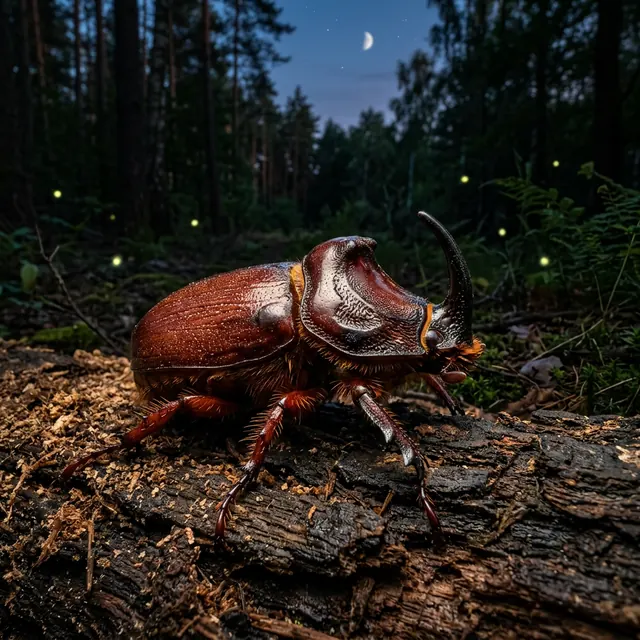
European rhinoceros beetle
Oryctes nasicornis
One of the largest beetles in Europe. The male has a curved horn on its head, like a rhinoceros. The larva is the largest beetle larva in Europe. It once lived in forests with rotting oaks; today it is found most often in sawmills, on heaps of old sawdust and bark, and in large compost heaps.
How to recognise
- Length 30–40 mm, body cylindrical and shiny
- Chestnut-brown, underside and legs with reddish hairs
- Male with a large horn on the head, curved backwards
- Female without a horn, with a small bump
Where it lives
Lowlands and warm foothills. Open deciduous forests, large parks, sawmills, sawdust and compost dumps.
When you'll see it
Adults fly from the end of June to the end of August, at dusk and at night. The larva develops for 3–5 years.
Tracks
In old sawdust or compost, thick white grubs bent into a C shape, up to 12 cm, with a dark head. Egg-shaped pupal chambers the size of a hen's egg, moulded from clay, wood mould and sawdust.
Tracks
Close-up of a huge creamy white C-shaped rhinoceros beetle grub about 10 cm long with a dark brown head, lying in dark crumbly sawdust compost, next to an egg-sized oval pupal chamber made of soil and wood fragments, realistic. Realistic nature photograph, no people, no text, square composition.
When you meet it
Harmless. On warm nights it flies to street lamps and often falls on its back, and on a smooth surface it has trouble turning over. You can gently set it back on its feet and move it into the grass. Do not dig up old compost in midsummer.
Role in the forest
The larvae break down rotting wood, sawdust and plant remains.
Fun fact
The adult rhinoceros beetle probably eats nothing and lives on reserves stored by the larva. In 1985 in Damnica near Słupsk, about 400 dead individuals were found on a heap of old sawdust covering about 200 m². The larvae are attacked by the wasp Regiscolia maculata of the family Scoliidae: it lays an egg in the grub, and its larva eats the grub from the inside.