

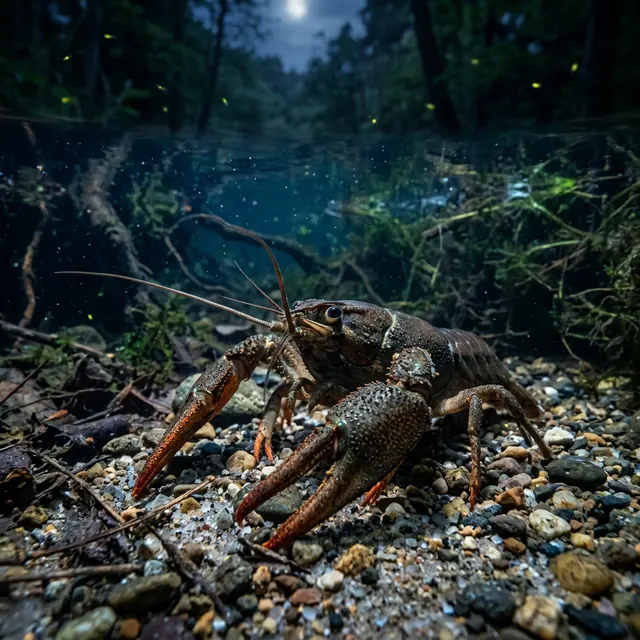
Noble crayfish
Astacus astacus
A native freshwater crayfish, called the barometer of water purity because it lives only in clean, oxygen-rich waters. It is dying out because of crayfish plague, a disease brought from North America together with alien crayfish, which are themselves resistant to it. Since the disease appeared, its numbers have fallen to about 5% of what they once were.
How to recognise
- Males up to 16 cm, females up to 12 cm
- Pincers short, broad and thick, reddish underneath
- Eyes on stalks, each looking independently
- A fan-shaped tail of 5 plates on the abdomen
Where it lives
Clean, oxygen-rich rivers, streams and lakes, in lowlands and uplands. It avoids muddy and swampy bottoms.
When you'll see it
Active at night, most of all on warm, cloudy nights. Mating from mid-October to mid-November. It does not eat in winter.
Tracks
Burrows dug in the bank, hideouts under tree roots and stones in the shallows.
Tracks
Close-up of a crayfish burrow opening in a clay stream bank under exposed tree roots just below the water surface, clear water, realistic. Realistic nature photograph, no people, no text, square composition.
When you meet it
The crayfish is protected, do not catch it. Never release aquarium crayfish or crayfish of alien species into waters, because they are the ones that spread crayfish plague. If picked up clumsily, it can pinch painfully.
Role in the forest
A keystone species of waters. It eats mainly aquatic plants, and also small invertebrates and carrion, and cleans the bottom. Without crayfish, water bodies become overgrown faster.
Fun fact
Poland was famous for its crayfish. In 1927, 611 tonnes of them were exported. The female carries fertilised eggs glued under her abdomen all winter, until spring. While moulting, the crayfish has no hard shell for about two days and easily falls prey to perch and eels.