

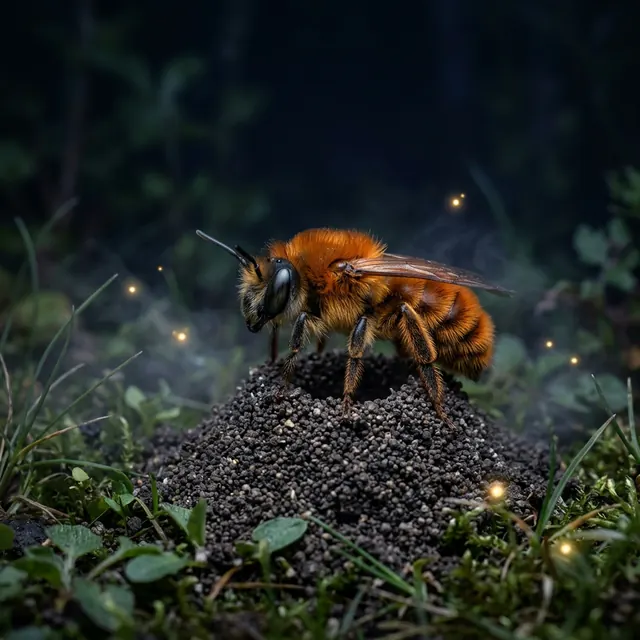
Tawny mining bee
Andrena fulva
A solitary bee that digs its nests in the ground. The female wears a dense, reddish-golden coat. It reached Poland in the 20th century and spread across the country. It is widespread, but not very numerous. It copes well with the city, noise and exhaust fumes.
How to recognise
- Female 12–14 mm, the size of a honey bee worker
- The female's back is covered with dense, bristling, reddish-golden to bright red hair, the underside and legs black
- The male is smaller, 10–12 mm, less bright
- At the burrow in a lawn you can see a small mound of earth
Where it lives
Light forests, dry meadows, parks and gardens. Nests in the ground on paths, lawns and slopes, often many side by side.
When you'll see it
From mid-March to the beginning of June. One generation a year. After mating the female lives only 2–3 weeks.
Tracks
Mounds of earth at the entrance to the burrow, with a radius of about 3 cm and a height of up to 3 cm. The tunnel is about 9 mm in diameter, and the cells with larvae lie up to 50 cm underground. On 5 m² there can be from several dozen to several hundred nests.
Tracks
Close-up of several small volcano-shaped mounds of fine soil about 6 cm wide on a short lawn, each with a round entrance hole about 9 mm wide in the centre, nests of the tawny mining bee, realistic spring macro. Realistic nature photograph, no people, no text, square composition.
When you meet it
Do not destroy or flood a colony of nests in a lawn. For a few weeks in spring it is enough to go around the mounds and not mow very low. Do not pick the bee up in your hand. If you have signs of an allergy after a sting, call 112.
Role in the forest
In spring it pollinates fruit trees and berry bushes, among others apple, pear, cherry, currant and gooseberry, as well as maples, willows and hawthorns. It flies no further than about 250 m from the nest.
Fun fact
The female lines the cell for the larva with a secretion from the Dufour's gland. The secretion forms a smooth, waxy and waterproof layer that protects the pollen store from damp and microbes. The mining bee starts work at a lower temperature than the honey bee.