

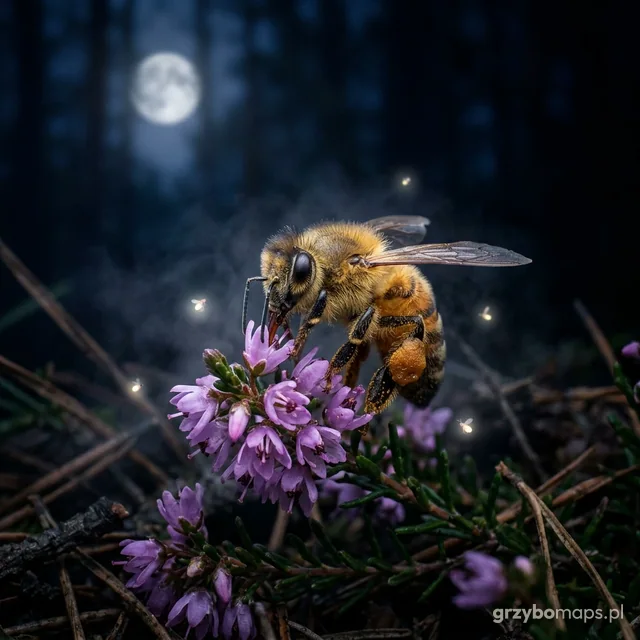
Honey bee
Apis mellifera
An insect kept by humans for thousands of years, but the workers forage far afield, including in the forest. Forest honey (honeydew honey) comes from the woods: it is made from the sweet honeydew excreted by aphids and scale insects on firs, spruces and oaks.
How to recognise
- About 1.2 cm, brownish, hairy
- Often has pollen pellets (pollen baskets) on the hind legs
- Works calmly on flowers
- After a sting, the stinger with its venom sac stays in the skin
Where it lives
Everywhere plants bloom. In the forest on heather, raspberries, lindens, acacias, and in the honeydew season in the crowns of conifers.
When you'll see it
Flights from March to October; on warm days in winter, short cleansing flights.
Tracks
Hives at the forest edge. Rarely, wild colonies in the hollows of old trees, with wax combs inside.
Tracks
Close-up of a wild honey bee colony inside a hollow of an old lime tree, pale wax combs hanging inside the cavity, bees on the combs, realistic natural light.
When you meet it
A bee away from the hive rarely stings. If it leaves its stinger, remove it at once, best by prying it out with a fingernail or the edge of a card. Speed matters, because the venom sac keeps pumping venom. Then apply a cold compress. If there are signs of allergy, namely shortness of breath, swelling, hives all over the body or dizziness, call 112.
Role in the forest
A pollinator of forest trees and shrubs, including raspberries, bilberries and lindens. It turns honeydew into honey that would otherwise remain in the forest.
What the beliefs say
In Polish folk culture the bee was considered a creature of God. It was said that a bee dies rather than perishes like an animal. On Christmas Eve beekeepers went to the hives to announce the birth of Christ to the bees, and when buying a swarm one was not allowed to haggle.
Fun fact
A worker that stings a human dies, because the barbed stinger stays in the elastic skin. She can sting another insect many times.